Tuesday, March 24, 2020

14. KABUKI BOOK COVERS: ICHIKAWAWA EBIZO: NARITAYA NO IKI TO TSUYA


This magazine-style book contains numerous photos of the actor Ichikawa Ebizō XI, who is scheduled to attain kabuki’s most renowned name, Ichikawa Danjūrō XIII, this year. It was published by Shōgakukan in 2010 and, as explained to me by Prof. Kei Hibino, was compiled for a bimonthly cultural publication called Waraku Mook. Waraku means "peace and harmony" and "mook" is a neologism for a combination of "book" and "magazine." I see no author's name. 

The book also contains a rather thorough English-language essay on the actor, and even an English-language title. Whereas the Japanese title could be rendered Ichikawa Ebizō: The Style and Luster of Naritaya (the last word being the family’s guild name or yagō), the English title given is Ichikawa Ebizō: “Ichikawa Ebizō XI, a young leader of kabuki for the 21st Century: Ebizō and the Ichikawa Danjūrō family.”

The photos are credited to Sasayama Kishin, the chief photographer of Engekikai, the kabuki magazine of record whose monthly issues are chronicled in this blog.


Wednesday, March 18, 2020

ENGEKIKAI (#4) April 2020: Cover and Contents


Kabuki Woogie is devoted to a variety of kabuki-related subjects. It began with a series of essays, including photos and videos, of a research trip to Japan in 2010, subsequently added my 25-chapter history of the first Kabuki-za, and then began a series of covers of and selected photos from Japanese books about kabuki from my collection. The current posting continues that series.
Kabuki Woogie also posts monthly covers of the kabuki magazine ENGEKIKAI, with details on their contents, and, when available, essays by guest contributors, including papers delivered at conferences and the like.

One can poke around in its archives to find past posts.

Photo: Sasayama Kishin.
The cover for the April 2020 issue (#4) of ENGEKIKAI, the kabuki magazine of record, pictures Kataoka Nizaemon XV as Kan Shōjō in the “Dōmyōji” scene of SUGAWARA DENJU TENARAI KAGAMI as produced in February 2020 at the Kabuki-za. The issue’s leading section contains illustrated articles about “Kabuki Gidayū,” the style of narrative accompaniment used in plays, like SUGAWARA, adapted by kabuki from the bunraku puppet theatre, where aone or more narrators and shamisen players provide the auditory part of the performance. The music is also called takemoto, and the “Appeal of Takemoto” forms a major part of the discussion. Interviews with the gidayū chanter Takemoto Aoidayū II and shamisen master Tsuruzawa Shinji are included. The issue also contains an interview with actor Nakamura Kankurō, an archival segment providing photos and discussion of famous actors of the late 20th century when they were kids doing fully staged children’s productions kabuki, “Chibiko Kabuki,” an explanatory overview of the kabuki play KOKORO NO NAZO TOKETA IROITO, and the latest installment of actor Matsumoto Kōshirō’s monthly series, “Kōshirō’s Thousand and One Nights.”

Monday, March 2, 2020

ENGEKIKAI (#3) March 2020: Cover and Contents


Kabuki Woogie is devoted to a variety of kabuki-related subjects. It began with a series of essays, including photos and videos, of a research trip to Japan in 2010, subsequently added my 25-chapter history of the first Kabuki-za, and then began a series of covers of and selected photos from Japanese books about kabuki from my collection. The current posting continues that series.
Kabuki Woogie also posts monthly covers of the kabuki magazine ENGEKIKAI, with details on their contents, and, when available, essays by guest contributors, including papers delivered at conferences and the like.
One can poke around in its archives to find past posts.
Photo: Sasayama Kishin.

The March 2020 issue (#3) of ENGEKIKAI, the kabuki magazine of record, returns to a traditional character and play, showing Nakamura Shikan as Abe Sadato in ŌSHŪ ADACHIGAHARa (SODEHAGI SAIMON), seen at the Kabuki-za in January. The boldest headline on the cover announces a section covering the first productions of the New Year, in January, at the Kabuki-za, the Kokuritsu Gekijō, the Shinbashi Enbujō, the Asakusa Kōkaidō, the Misono-za, and the Ōsaka Shōchiku-za. At the lower right is the headline for an interview with Kataoka Nizaemon on his performance in SUGAWARA DENJU TENARAI KAGAMI, one of kabuki’s foremost classics, in connection with a memorial production recognizing the 17th anniversary of the death of his father, Nizaemon XIII. Finally, although the issue contains considerably more than what’s on the cover, there’s the latest installment of Matsumoto Kōshirō’s series, “Kōshirō’s Thousand and One Nights” and a guide to the kabuki play KOI NO YAMI UKAI NO KAGARIBI.

Monday, February 24, 2020

ENGEKIKAI (#2) February 2020: Cover and Contents


Kabuki Woogie is devoted to a variety of kabuki-related subjects. It began with a series of essays, including photos and videos, of a research trip to Japan in 2010, subsequently added my 25-chapter history of the first Kabuki-za, and then began a series of covers of and selected photos from Japanese books about kabuki from my collection. The current posting continues that series.
Kabuki Woogie also posts monthly covers of tprhe kabuki magazine ENGEKIKAI, with details on their contents, and, when available, essays by guest contributors, including papers delivered at conferences and the like.

One can poke around in its archives to find past posts.


Onoe Kikunosuke as Naushika in Kaze no Tani no Naushika. Photo: Sasayama Kishin.
The February 2020 issue (#2) of ENGEKIKAI, the kabuki magazine of record, is a pathbreaker, showing not the usual traditional kabuki play but one of the increasingly common productions that seek to take kabuki theatre into the 21st century with stories and techniques inspired by the contemporary world. This movement, born in the mid-1980s, when Ichikawa Ennosuke II created his lavish productions—half Las Vegas spectacle, half kabuki conventions—has recently become a mini-flood with leading actors vying for new and exciting ways to bring young audiences to the theatre. A good recent discussion of the phen)omenon is available here.

The cover, then, is a photo of the December Kabuki-za production of the play whose 1984 anime original, created by Hayao Miyazaki, is known in English as NAUSICÄA OF THE VALLEY OF THE WIND (Kaze no Tani no Naushika). Starring as Naushika is the kabuki actor Onoe Kikunosuke. 

The headlines on the cover announce the issue’s major contents, beginning, at the upper left, with an article about performances judged by a roundtabe panel to be deserving of 2019’s Personal Favorite Kabuki Grand Prize (Kyokushiteki Kabuki Taishō). If anyone can offer a better version of this prize's name, please let me know on the Facebook kabuki page, or otherwise. Perhaps there's an official English name I'm not aware of. 

At the lower right we’re informed of an article about Kataoka Nizaemon in the “Yoshidaya” scene of KURUWA BUNSHŌ, while next to it is mentioned the latest installment of actor Matsumoto Kōshirō’s ongoing series, “Kōshirō’s Thousand and One Nights.” This is followed by an article on the recent production of KOMORI NO YASU-SAN, about a kabuki adaptation of Charlie Chaplin’s 1931 film, CITY LIGHTS, in which a popular kabuki character called “Bat Yasu” (Komori no Yasu-san), is converted to a Japanese version of the character played by Chaplin (see the entry for last month’s issue). Other articles are an interview with Kataoka Kamezō and an introduction to the traditional kabuki play KEISEI YAMATO SŌJI. Finally, notice is given of reviews for December productions at the Minami-za, the Kabuki-za, the Kokuritsu Gekijō (National Theatre), Shinbashi Enbujō, and elsewhere.


Wednesday, January 1, 2020

ENGEKIKAI (#1) January 2020: Cover and Contents

Kabuki Woogie is devoted to a variety of kabuki-related subjects. It began with a series of essays, including photos and videos, of a research trip to Japan in 2010, subsequently added my 25-chapter history of the first Kabuki-za, and then began a series of covers of and selected photos from Japanese books about kabuki from my collection. The current posting continues that series.
Kabuki Woogie also posts monthly covers of the kabuki magazine ENGEKIKAI, with details on their contents, and, when available, essays by guest contributors, including papers delivered at conferences and the like.
One can poke around in its archives to find past posts.

Nakamura Baigyoku, Nakamura Kangyoku in Kiichi Hōgen Sanryaku no Maki. Photo: Sasayama Kishin.


The January 2020 issue (#1) of ENGEKIKAI, the kabuki magazine of record, has a cover showing Nakamura Baigyoku IV (left) as Chienai (in reality Yoshioka Kisanta), and his disciple, the newly named Nakamura Kangyoku I, formerly called Nakamura Umemaru, during this production of KIICHI HŌGEN SANRYAKU NO MAKI at the Kabuki-za in November. The issue’s chief contents, headlined on the cover, include a major section called “Good Luck to Kabuki in 2020!” It contains discussions between actors Kataoka Nizaemon and Kataoka Sennosuke, and between actors Nakamura Tōzō and Nakamura Tamatarō. It also includes interviews with the actors scheduled to appear in January’s Asakusa Kabuki program: Onoe Matsuya, Nakamura Kashō, Bandō Tomoenosuke, Bandō Shingo, Nakamura Yonekichi, Nakamura Hayato, and Nakamura Hashinosuke. On the right of the cover is an announcement that purchasers of the issue will receive a kabuki actor calendar, each month of which is graced by the cover photo used for that month in 2019.

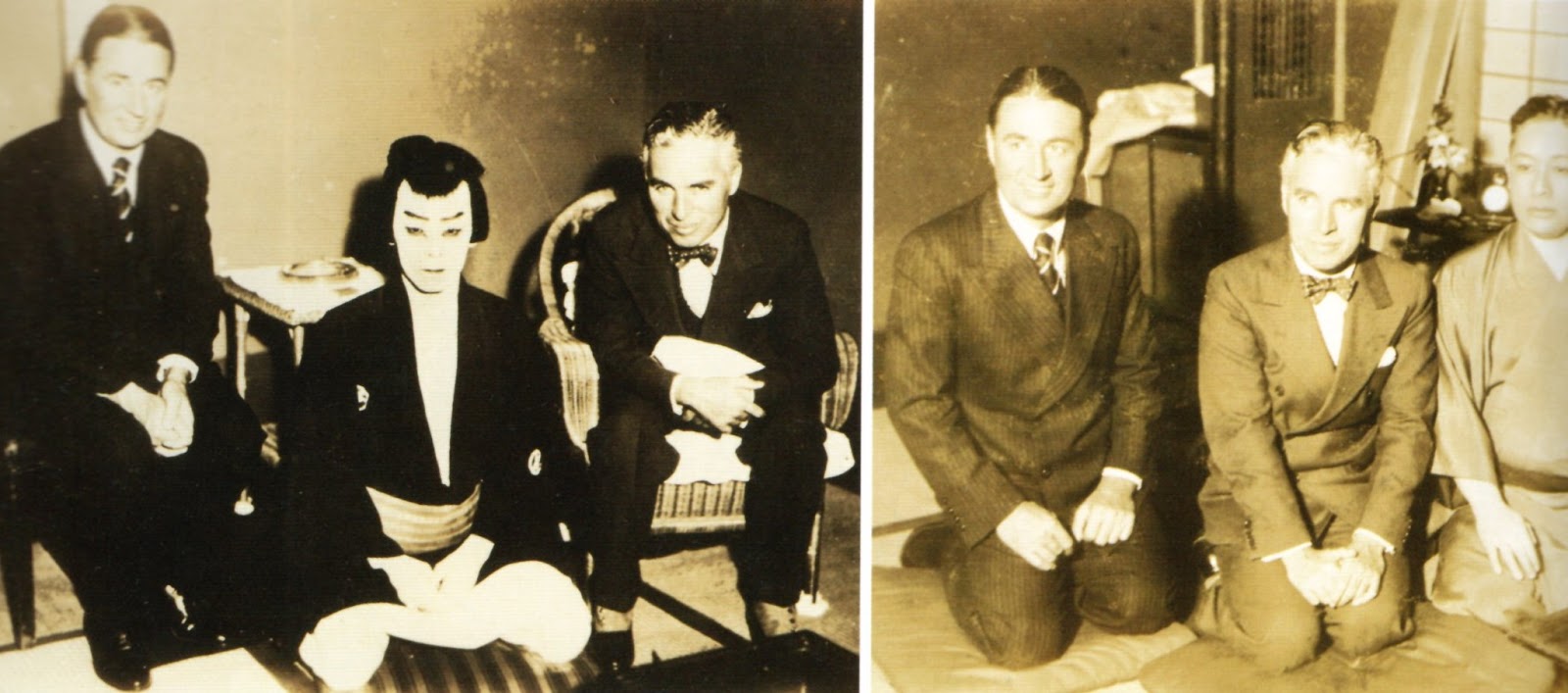
Kabuki and Chaplin

Of greatest interest in this issue is the title at the bottom of the cover “Kabuki X Chaplin,” a section devoted to Charlie Chaplin and kabuki. It describes the background to a production that actually came off in December of a play, KOMORI NO YASUSAN (Bat-man Yasu), written by Kimura Kinka as a kabuki version of Chaplin’s 1931 City Lights. Its first performance was at the Kabuki-za in August 1931, only months after the film itself was released, with Morita Kanya XIII as the Chaplinesque tramp, Komori no Yasu (a popular character in the kabuki play GENJIDANA). 

Matsumoto Kōshirō X as Komori no Yasusan.
Charlie Chaplin.

The 2019 revival was the work of actor Matsumoto Kōshirō X and writer Ono Hiroyuki. “From Chaplin to Kabuki,” a fascinating talk by Ono, in English, about how the show came to be is here. I regret not having been in Japan to see the production but Ono’s excellent talk—written when the project was in its preparatory stages—should prove of considerable assistance in describing it.
Left: Sidney Chaplin (Charlie's brother), Nakamura Kichiemon I, and Charlie Chaplin; right: Sidney Chaplin, Charlie Chaplin, and Onoe Kikugorō VI.


Saturday, December 28, 2019

13. KABUKI BOOK COVERS: PASSION: ENNOSUKE TO NIJŪICHI SEIKI KABUKI GUMI

Kabuki Woogie is devoted to a variety of kabuki-related subjects. It began with a series of essays, including photos and videos, of a research trip to Japan in 2010, subsequently added my 25-chapter history of the first Kabuki-za, and then began a series of covers of and selected photos from Japanese books about kabuki from my collection. The current posting continues that series.

Kabuki Woogie also posts monthly covers of the kabuki magazine ENGEKIKAI, with details on their contents, and, when available, essays by guest contributors, including papers delivered at conferences and the like.

One can poke around in its archives to find past posts.


The present posting shows the English-titled Passion, a soft-cover, coffee-table book, published in 1997 by NHK, devoted mainly to photos of Ichikawa Ennosuke III (later Ichikawa En’ō II) during his heyday, when he was the artistic director of the pathbreaking troupe, Nijūichiseiki Kabuki Gumi (Twenty-First Century Kabuki Group), which is famous for producing spectacular productions called Super Kabuki. Ennosuke suffered a stroke in 2003 and his stage appearances since have been very limited. Ennosuke III took the name En’ō II in 2012, and his nephew, Ichikawa Kamejirō II, became Ennosuke IV. The captions refer to the star as Ennosuke III, his former name.


Table of Contents

Ennosuke III as the Emperor in Kaguya, 1996, at the Shinbashi Enbujō, Tokyo.

哀国林, one of several Chinese actors who appeared with Ennosuke in his Super Kabuki,
Ryūō (The Dragon King), at the Shinbashi Enbujō, March 1989. Ennosuke was very interested in combining the conventions of kabuki with those of jingju.
Ennosuke III as the earth spider in Shitennō Momiji no Edo Guma, at the Kokuritsu Gekijō, March 1995.


Publication page for Passion.

Monday, December 16, 2019

ENGEKIKAI (#9) September 2019: Cover and Contents (erroneous listing)

Apologies. I posted this before realizing I'd already described the #9 September 2019 cover and contents of ENGEKIKAI, although in slightly different words. So it's not belated; just more or less a repeat of what I already posted. I'm leaving it up for the time being but will eventually take it down.

Kabuki Woogie is devoted to a variety of kabuki-related subjects. It began with a series of essays, including photos and videos, of a research trip to Japan in 2010, subsequently added my 25-chapter history of the first Kabuki-za, and then began a series on Japanese books about kabuki from my collection. It also posts the monthly covers of Engekikai, the kabuki magazine of record. When possible, it will offer occasional essays by guest contributors based on papers they delivered at conferences and symposiums. One can poke around in its archives to find all of these past posts.

This issue, which arrived late, was not previously recorded in Kabuki Woogie. It fills in what was, until now, a gap in the chronological entries for ENGEKIKAI covers of the recent past.

The cover of ENGEKIKAI, the kabuki magazine of record, for September 2019 shows Ichikawa Ebizō in the role of the medicine seller in UIRŌ-URI, one of the plays in the Ichikawa Danjūrō family line’s Kabuki Jūhachiban (The Kabuki Eighteen) collection. The issue’s chief section, headlined at the upper left, includes illustrated essays about “The Young Warriors of Reiwa,” meaning the boy actors of the new Reiwa era who are being groomed for stardom. These are listed as Ichikawa Danko, Ichikawa Somegorō, Onoe Sakon, Ōtani Tatsuo, and Ichikawa Sakon. Contents listed along the bottom include an interview with Nakamura Shichinosuke, another with Onoe Ukon, a piece about Sawamura Kunio and the Superkabuki production this past August at Kyoto’s Minami-za in honor of its reopening following renovation, reviews of October’s kabuki productions, the latest entry in Matsumoto Kōshirō’s monthly “Kōshirō’s 1,001 Nights” series, and, most interestingly, a section of archival photos of ghost play (kaidan kyōgen) productions.

This issue celebrates the 12th anniversary of ENGEKIKAI’s revising its format. Accordingly, the cover announces that the magazine is providing the gift of an actor-signed hand towel (tenugui), although I don’t ever seem to have received mine.

Ichikawa Ebizō as the medicine seller in UIRŌ-URI. Photo: Sasayama Kishin.