Monday, February 24, 2020

ENGEKIKAI (#2) February 2020: Cover and Contents


Kabuki Woogie is devoted to a variety of kabuki-related subjects. It began with a series of essays, including photos and videos, of a research trip to Japan in 2010, subsequently added my 25-chapter history of the first Kabuki-za, and then began a series of covers of and selected photos from Japanese books about kabuki from my collection. The current posting continues that series.
Kabuki Woogie also posts monthly covers of tprhe kabuki magazine ENGEKIKAI, with details on their contents, and, when available, essays by guest contributors, including papers delivered at conferences and the like.

One can poke around in its archives to find past posts.


Onoe Kikunosuke as Naushika in Kaze no Tani no Naushika. Photo: Sasayama Kishin.
The February 2020 issue (#2) of ENGEKIKAI, the kabuki magazine of record, is a pathbreaker, showing not the usual traditional kabuki play but one of the increasingly common productions that seek to take kabuki theatre into the 21st century with stories and techniques inspired by the contemporary world. This movement, born in the mid-1980s, when Ichikawa Ennosuke II created his lavish productions—half Las Vegas spectacle, half kabuki conventions—has recently become a mini-flood with leading actors vying for new and exciting ways to bring young audiences to the theatre. A good recent discussion of the phen)omenon is available here.

The cover, then, is a photo of the December Kabuki-za production of the play whose 1984 anime original, created by Hayao Miyazaki, is known in English as NAUSICÄA OF THE VALLEY OF THE WIND (Kaze no Tani no Naushika). Starring as Naushika is the kabuki actor Onoe Kikunosuke. 

The headlines on the cover announce the issue’s major contents, beginning, at the upper left, with an article about performances judged by a roundtabe panel to be deserving of 2019’s Personal Favorite Kabuki Grand Prize (Kyokushiteki Kabuki Taishō). If anyone can offer a better version of this prize's name, please let me know on the Facebook kabuki page, or otherwise. Perhaps there's an official English name I'm not aware of. 

At the lower right we’re informed of an article about Kataoka Nizaemon in the “Yoshidaya” scene of KURUWA BUNSHŌ, while next to it is mentioned the latest installment of actor Matsumoto Kōshirō’s ongoing series, “Kōshirō’s Thousand and One Nights.” This is followed by an article on the recent production of KOMORI NO YASU-SAN, about a kabuki adaptation of Charlie Chaplin’s 1931 film, CITY LIGHTS, in which a popular kabuki character called “Bat Yasu” (Komori no Yasu-san), is converted to a Japanese version of the character played by Chaplin (see the entry for last month’s issue). Other articles are an interview with Kataoka Kamezō and an introduction to the traditional kabuki play KEISEI YAMATO SŌJI. Finally, notice is given of reviews for December productions at the Minami-za, the Kabuki-za, the Kokuritsu Gekijō (National Theatre), Shinbashi Enbujō, and elsewhere.


Wednesday, January 1, 2020

ENGEKIKAI (#1) January 2020: Cover and Contents

Kabuki Woogie is devoted to a variety of kabuki-related subjects. It began with a series of essays, including photos and videos, of a research trip to Japan in 2010, subsequently added my 25-chapter history of the first Kabuki-za, and then began a series of covers of and selected photos from Japanese books about kabuki from my collection. The current posting continues that series.
Kabuki Woogie also posts monthly covers of the kabuki magazine ENGEKIKAI, with details on their contents, and, when available, essays by guest contributors, including papers delivered at conferences and the like.
One can poke around in its archives to find past posts.

Nakamura Baigyoku, Nakamura Kangyoku in Kiichi Hōgen Sanryaku no Maki. Photo: Sasayama Kishin.


The January 2020 issue (#1) of ENGEKIKAI, the kabuki magazine of record, has a cover showing Nakamura Baigyoku IV (left) as Chienai (in reality Yoshioka Kisanta), and his disciple, the newly named Nakamura Kangyoku I, formerly called Nakamura Umemaru, during this production of KIICHI HŌGEN SANRYAKU NO MAKI at the Kabuki-za in November. The issue’s chief contents, headlined on the cover, include a major section called “Good Luck to Kabuki in 2020!” It contains discussions between actors Kataoka Nizaemon and Kataoka Sennosuke, and between actors Nakamura Tōzō and Nakamura Tamatarō. It also includes interviews with the actors scheduled to appear in January’s Asakusa Kabuki program: Onoe Matsuya, Nakamura Kashō, Bandō Tomoenosuke, Bandō Shingo, Nakamura Yonekichi, Nakamura Hayato, and Nakamura Hashinosuke. On the right of the cover is an announcement that purchasers of the issue will receive a kabuki actor calendar, each month of which is graced by the cover photo used for that month in 2019.

Kabuki and Chaplin

Of greatest interest in this issue is the title at the bottom of the cover “Kabuki X Chaplin,” a section devoted to Charlie Chaplin and kabuki. It describes the background to a production that actually came off in December of a play, KOMORI NO YASUSAN (Bat-man Yasu), written by Kimura Kinka as a kabuki version of Chaplin’s 1931 City Lights. Its first performance was at the Kabuki-za in August 1931, only months after the film itself was released, with Morita Kanya XIII as the Chaplinesque tramp, Komori no Yasu (a popular character in the kabuki play GENJIDANA). 

Matsumoto Kōshirō X as Komori no Yasusan.
Charlie Chaplin.

The 2019 revival was the work of actor Matsumoto Kōshirō X and writer Ono Hiroyuki. “From Chaplin to Kabuki,” a fascinating talk by Ono, in English, about how the show came to be is here. I regret not having been in Japan to see the production but Ono’s excellent talk—written when the project was in its preparatory stages—should prove of considerable assistance in describing it.
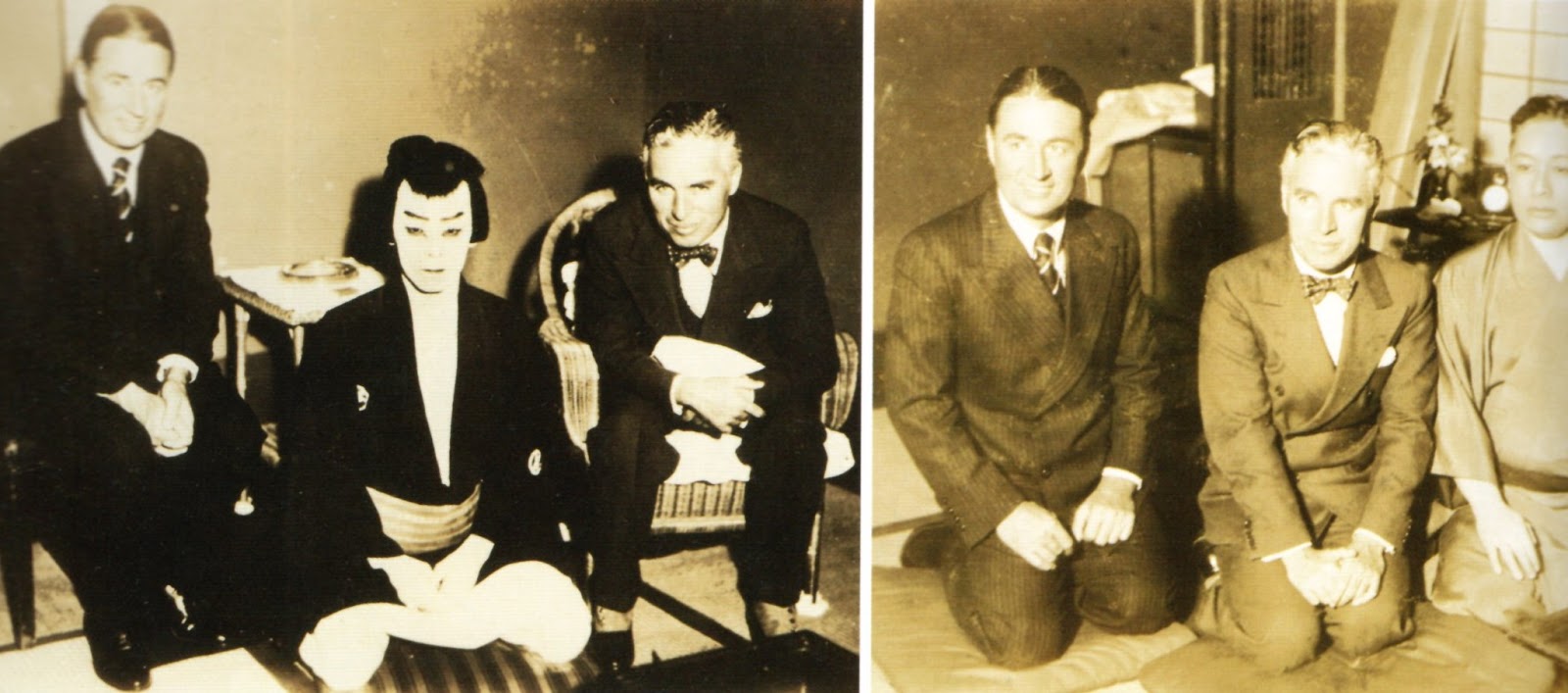
Left: Sidney Chaplin (Charlie's brother), Nakamura Kichiemon I, and Charlie Chaplin; right: Sidney Chaplin, Charlie Chaplin, and Onoe Kikugorō VI.


Saturday, December 28, 2019

13. KABUKI BOOK COVERS: PASSION: ENNOSUKE TO NIJŪICHI SEIKI KABUKI GUMI

Kabuki Woogie is devoted to a variety of kabuki-related subjects. It began with a series of essays, including photos and videos, of a research trip to Japan in 2010, subsequently added my 25-chapter history of the first Kabuki-za, and then began a series of covers of and selected photos from Japanese books about kabuki from my collection. The current posting continues that series.

Kabuki Woogie also posts monthly covers of the kabuki magazine ENGEKIKAI, with details on their contents, and, when available, essays by guest contributors, including papers delivered at conferences and the like.

One can poke around in its archives to find past posts.


The present posting shows the English-titled Passion, a soft-cover, coffee-table book, published in 1997 by NHK, devoted mainly to photos of Ichikawa Ennosuke III (later Ichikawa En’ō II) during his heyday, when he was the artistic director of the pathbreaking troupe, Nijūichiseiki Kabuki Gumi (Twenty-First Century Kabuki Group), which is famous for producing spectacular productions called Super Kabuki. Ennosuke suffered a stroke in 2003 and his stage appearances since have been very limited. Ennosuke III took the name En’ō II in 2012, and his nephew, Ichikawa Kamejirō II, became Ennosuke IV. The captions refer to the star as Ennosuke III, his former name.


Table of Contents

Ennosuke III as the Emperor in Kaguya, 1996, at the Shinbashi Enbujō, Tokyo.

哀国林, one of several Chinese actors who appeared with Ennosuke in his Super Kabuki,
Ryūō (The Dragon King), at the Shinbashi Enbujō, March 1989. Ennosuke was very interested in combining the conventions of kabuki with those of jingju.
Ennosuke III as the earth spider in Shitennō Momiji no Edo Guma, at the Kokuritsu Gekijō, March 1995.


Publication page for Passion.

Monday, December 16, 2019

ENGEKIKAI (#9) September 2019: Cover and Contents (erroneous listing)

Apologies. I posted this before realizing I'd already described the #9 September 2019 cover and contents of ENGEKIKAI, although in slightly different words. So it's not belated; just more or less a repeat of what I already posted. I'm leaving it up for the time being but will eventually take it down.

Kabuki Woogie is devoted to a variety of kabuki-related subjects. It began with a series of essays, including photos and videos, of a research trip to Japan in 2010, subsequently added my 25-chapter history of the first Kabuki-za, and then began a series on Japanese books about kabuki from my collection. It also posts the monthly covers of Engekikai, the kabuki magazine of record. When possible, it will offer occasional essays by guest contributors based on papers they delivered at conferences and symposiums. One can poke around in its archives to find all of these past posts.

This issue, which arrived late, was not previously recorded in Kabuki Woogie. It fills in what was, until now, a gap in the chronological entries for ENGEKIKAI covers of the recent past.

The cover of ENGEKIKAI, the kabuki magazine of record, for September 2019 shows Ichikawa Ebizō in the role of the medicine seller in UIRŌ-URI, one of the plays in the Ichikawa Danjūrō family line’s Kabuki Jūhachiban (The Kabuki Eighteen) collection. The issue’s chief section, headlined at the upper left, includes illustrated essays about “The Young Warriors of Reiwa,” meaning the boy actors of the new Reiwa era who are being groomed for stardom. These are listed as Ichikawa Danko, Ichikawa Somegorō, Onoe Sakon, Ōtani Tatsuo, and Ichikawa Sakon. Contents listed along the bottom include an interview with Nakamura Shichinosuke, another with Onoe Ukon, a piece about Sawamura Kunio and the Superkabuki production this past August at Kyoto’s Minami-za in honor of its reopening following renovation, reviews of October’s kabuki productions, the latest entry in Matsumoto Kōshirō’s monthly “Kōshirō’s 1,001 Nights” series, and, most interestingly, a section of archival photos of ghost play (kaidan kyōgen) productions.

This issue celebrates the 12th anniversary of ENGEKIKAI’s revising its format. Accordingly, the cover announces that the magazine is providing the gift of an actor-signed hand towel (tenugui), although I don’t ever seem to have received mine.

Ichikawa Ebizō as the medicine seller in UIRŌ-URI. Photo: Sasayama Kishin.


Tuesday, December 10, 2019

ENGEKIKAI (#12) December 2019: Cover and Contents


Kabuki Woogie is devoted to a variety of kabuki-related subjects. It began with a series of essays, including photos and videos, of a research trip to Japan in 2010, subsequently added my 25-chapter history of the first Kabuki-za, and then began a series on Japanese books about kabuki from my collection. It also posts the monthly covers of Engekikai, the kabuki magazine of record. It also may add occasional essays by guest contributors based on papers they delivered at conferences and symposiums. One can poke around in its archives to find all of these past posts.
\
The cover of ENGEKIKAI, the monthly kabuki magazine of record, shows Onoe Kikugorō VII as Sashichi, the title role in Edo Sodachi Omatsuri Sashichi, performed at the Kabuki-za in October. The issue’s chief section is called “An Invitation to the Kaomise Performances, East and West,” which covers the annual kaomise (“face-showing”) productions. These recall the tradition of November being the kick-off month for a new theatrical season, and the coverage looks at this year’s relevant productions in Tokyo and elsewhere. Related to this are interviews with two veteran stars, Sakata Tōjūrō and Onoe Kikugorō. Other contents outlined on the cover (more are inside) include an interview with actor Nakamura Senjaku; and another with the actor formerly known as Nakamura Umemaru, who took the name Nakamura Kangyaku in November. There’s also an illustrated report on a “study group” (benkyōkai) performance by Nakamura Takanosuke, son of the late Nakamura Tomijūrō V, celebrating the birth of Tomijūrō I, 300 years ago. The issue also contains the latest entry in “Kōshirō’s 1,001 Nights” series, and a well-illustrated piece on the new kabuki play based on the famous Hayao Miyazaki anime, NAUSICAÄ of THE VALLEY OF THE WIND (Kaze no Tani no Naushika). It includes a discussion among actors Onoe Kikunosuke and Nakamura Shichinosuke, and Suzuki Toshio, co-founder and producer of Ghibli Studio, which created the original movie. Here’s an article about the project, which is currently on stage at Tokyo’s Shinbashi Enbujō. 

Engekikai (#12), December 2019. Photo: Sasayama Kishin.


Saturday, November 30, 2019

LEONARD PRONKO


Leonard Pronko. If anyone can identify the conference at which the photos of Leonard were taken (the workshop one below will help), please notify me/
Leonard Cabell Pronko (1927-2019) passed away on November 27. A professor at Pomona College, Claremont, CA, he was one of the West's leading experts on kabuki, although he was also a scholar of modern French theatre. He not only wrote about kabuki in books and articles, but actually practiced it, giving performances as well as directing college students in traditional kabuki in English, Western plays written for kabuki-style performance, and classics, like Macbeth, conceived in kabuki style. He was a larger-than-life presence, a charismatic teacher, world traveler, and the warmest of friends.  
With Leonard and another scholar. I'm in the middle. Please let me know if you recognize the man on the left.
I first met him in Tokyo, in 1963, when he was on a Guggenheim research trip to study Asian theatre, and I was an East-West Fellowship student studying kabuki for my MFA at the University of Hawaii, where I would do for my thesis--a production of Brecht's The Caucasian Chalk Circle in kabuki style--what Len would spend his life doing and both writing and lecturing about.

We had a prolific correspondence over the years, sharing our work, and happy for the occasions provided by professional activities to get together somewhere every now and so often.
Leonard Pronko conducting a kabuki workshop.
To my knowledge, the first publication expressing his ideas about kabuki was an interview in Engekikai, January 1964. I still have that issue and have translated it below, perhaps a bit roughly, but close enough to Len's words to convey their intentions. He appears to have given the interview in both English and Japanese, which surprises me as I wasn't aware that his Japanese at that early stage in his kabuki interests was so advanced.

Pay attention to the interstitial notes of the interviewer, Nagano Reiko, whose reactions to Leonard's obviously enthusiastic discourse show how impressed she was.
Leonard Pronko.
The pictures below show the cover of Engekikai, January 1964, and the two-page interview itself.

Cover of Engekikai, January 1964, showing Ichikawa Danjūrō as Kumedera Danjō in Kenuki.


“Foreigners’ Views of Kabuki:
Leonard Pronko”
Interviewed by Reiko Nagano
Translated by Samuel L. Leiter
Engekikai, January 1964: pp. 110-111

Leonard Pronko: Kabuki is fantastic. Really fantastic. I’ve seen nō and bunraku but I don't think there's anything better than kabuki.

Ever since I arrived in Japan in June I’ve been completely captivated by kabuki. . . . I’ve been going an average of three times a month, sometimes as often as five. For example, the recent full-length production of Yoshitsune Senbon Zakura. . . . I saw a rehearsal, and then four performances. The next month I went to Nagoya for two days of kabuki in a row. I’m squeezed into the Kabuki-za from 10:30 a.m. to after 9:00 p.m. but I just don’t get tired. At night, even when I’m in bed with my eyes closed, stage scenes flit by my eyes, one after the other. . . . Once I’m caught up in that world, the dream drama unfolding before my eyes makes me forget everything else. Kabuki has such a strange attraction and atmosphere, an attraction I don’t see in Western theatre, so I absolutely must study it.

[Nagano: He speaks rapidly, his tone passionate from the get-go. Now and then Mr. Pronko interjects rather good Japanese into the conversation.

A professor of French literature at Pomona College, California, he focuses on French theatre (while embracing all of Western theatre) and its mutual relationship with Asian theatre. He currently holds a Guggenheim Fellowship allowing him to visit Asia to research its theatre in situ.   

He studied at Paris’s famed Charles Dullin École and Théâtre National Populaire, among other institutions, and became fascinated by kabuki, so different from Western theatre. He says he plans to publish a book about kabuki in the near future. He also has directed plays at his college. Mr. Pronko offered thoughts on kabuki that make him different from all those other foreigners who recently have suddenly have taken such an interest in kabuki.]

Pronko: There are many Western theatre practitioners, especially actors and directors, who should be learning from Japanese traditional theatre, kabuki, noh, and bunraku. The basis of my current research involves pointing out their particular excellences. To begin with, Western drama tends to be overly intellectual, and theatregoers are forced to concentrate on the dialogue and its symbolic meanings.

Kabuki, on the contrary, is filled with a great abundance of beauties and pleasures. It synthesizes the delights of many stage arts into a single one. Take, for instance, Senbon Zakura, which skillfully blends the flamboyant stylization of aragoto acting with the elements of realistic sewa, everyday-style acting. The gorgeous spectacle of the michiyuki travel-dance scene is matched—in the true sense of the word—by the “dramatic” quality of the “Tōkaiya” scene. The three components of drama, music, and dance are in perfect harmony, providing a truly enjoyable experience.

[Nagano: His specialized interests aside, Mr. Pronko’s deep knowledge and enthusiasm practically bowled me over. Soon, he spoke of the differences between realism and theatrical stylization.]

Pronko: It’s once again necessary to reconsider Western realism. In this connection, what we study in kabuki touches the fundamental nature of theatre. Modern Western theatre usually has pursued realism, seeking to reproduce the reality of life on stage. However, actuality on stage is no more than an outline. It’s impossible to put real life on stage. Even so, kabuki, at first sight having no relation to realism, actually creates a kind of realism that goes beyond an outline. Through the transcendence of kabuki’s uniquely stylized acting, so-called realism beautifully enlarges the actuality of real life, transforming its appearance, and crafting a theatrical reality sublimated by the stage, which is how I understand it. Since the theory of realism is transcended, it has no limits in kabuki.

How can this theatrical reality lucidly handle things like complex, difficult, psychological issues? For example, there’s Matsuō in “Terakoya.” On the realistic stage, Matsuō’s expressions as he stares at the severed head of his own son, would seem ridiculously exaggerated. But the exaggerated movements of his eyes and eyebrows enhance Matsuō’s anguish, making them all the more powerfully expressive. Ichikawa Danjūrō XI’s Matsuō was exceptional, wasn’t it? He raised his eyebrows like this, used his eyes like this, raised his voice like this. . . . (Mr. Pronko demonstrated with considerable facility.)

I think the greatest ingredient in kabuki’s unique arsenal of stylized acting is the mie pose. The moment a mie performed, the hero’s expression and state of mind are proportionately enlarged. There’s no way that Western theatre’s realism can match such overwhelming expressiveness. The scene when Nikki Danjō rises on the hanamichi in Meiboku Sendai Hagi’s “Yuka no Shita” scene, or his entrance in that play’s “Ninjō” scene are classics of this device. I can only imagine how exciting it would be if Shakespeare’s plays, Macbeth, for example, were to use such stylized kabuki techniques.

It’s easy to understand the emphatic effect brought to the stage by kabuki’s painted-face makeup (kumadori) and its elaborate costumes. That is, stylized methods like these bind style and objective in perfect unity. The actor’s every movement being thus enlarged, he's totally invested, down to his toe-tips, with nothing wasted, his body no less powerful than his facial expressions. In contrast, the Western actor’s arms and legs are little more than long, useless appendages.

[Nagano: The more fervently he enthuses about kabuki, the faster his speech grows. I asked Mr. Pronko, who could talk about kabuki all day, what it is in kabuki that a foreigner likes, and what obstacles there are to understanding it.]

Pronko: The language, of course, is a big problem. Even though the way the actors express themselves and use their costumes during the gidayū narration and the long scenes of dialogue are understandable, it’s not so easy to follow the complex situations and the development of the plot. But isn’t that true for the average Japanese? Performers and aficionados have no problem following the give and take of the original scripts. They may perversely insist in sticking to the originals but if the audience can’t understand they’ll get bored and things will backfire. I wonder what would happen if they thought about revising the scripts in a way that wouldn’t damage the originals. A full-length version of Hamlet would take four hours to perform but, according to a director’s interpretation, it’s normal for it to get shortened to three or three and a half hours. I feel that this kind of thing is one way that kabuki could learn something from Western theatre practice.

And what of the objections to the feudalistic thematic backgrounds? There are many examples, like, for instance, one motif that's hard to accept as is would be the sacrifice of one’s own child for the sake of one’s master. I guess you simply have to transcend it. But the fundamental theme of loyalty and fidelity are universal, and feelings of anguish, doubt, and sorrow supersede all differences of social systems. The point is whether or not you can empathize with the drama.

What about the onnagata? This, too, is something representative of what makes kabuki performance unique and outstanding. Even to eyes that know a man is performing as a woman there’s absolutely nothing strange about it because, oddly, it makes concrete the essence of femininity. The other day, when I saw a shinpa performance in which an actress and an onnagata appeared together on the same stage, I was shocked by the difference in how “woman” was shown. That’s because the onnagata was rather natural and seemed quite womanish. The onnagata’s voice is fine, you know. While it’s a constructed voice you could also say it’s a theatrical voice. (Here he gives his impression of an onnagata’s voice.) In a manner of speaking, you could think of it as feeling like a piece of ancient, worn-out silk.

[Nagano: Of course, this is Mr. Pronko’s personal interpretation. I then asked him about his thoughts, critical and otherwise, on kabuki’s present and future existence.]

Pronko: The new kabuki plays (shinsaku mono) won’t do. Kabuki has kabuki performance methods, and there are many fine plays. And kabuki theatregoers want to see “kabuki.” Something creates a desire to do plays that imitate the methods of modern drama. I can’t help thinking that the staging methods of recent shinsaku are committing a serious error with regard to kabuki’s future. I’m not saying that plays dealing with contemporary issues shouldn't be produced; for example, even Chikamatsu's plays have realistic aspects and new themes. Nevertheless, they’re performed within the framework of kabuki tradition. If shinsaku are absolutely necessary, I think this is how they should be performed.

I hear that the younger generation is unfamiliar with kabuki, which is really a shame. This superb form of theatre has been transmitted to us down the years but its value is unknown. When only the world’s actuality is shown, what happens is that there’s no room to enjoy the world of drama. One solution is to give kids a chance to experience kabuki from their childhood on. It’s imperative that the younger generation knows kabuki and grows up within its atmosphere. This will give birth to a new life for kabuki. France has a system for introducing classical drama to children. They may not completely understand it, but they at least acquire a familiarity with classical drama.

[Nagano: The face of Engekikai’s Tsurumi-san, who was present, lit up at the mention of a kabuki classroom (kabuki kyōshitsu). . . . . SLL: A regular system of special performances for schoolchildren was already in place, and continues today.]

Pronko: That’s excellent. If more assistance could be provided for it, and if there were guidance for the mutual benefit of the younger generation of actors and audiences, it would really be great for everyone.

[Nagano: Mr. Pronko, who was anticipating the imminent arrival in Japan of visits by traditional Chinese and Indian performances, concluded thusly:)

Pronko: How much will Western theatre, ignorant till now of Eastern theatre, be able to learn from it? In order to know concretely, nothing’s better than to actually see different types of theatre. After I return to America, I’m going to look for such opportunities. I think I want to create plays that use kabuki style, and perform them. The themes may be my own, but they will make full use of kabuki techniques. I sincerely hope that they will give rise to theatrical harmony.


Friday, November 8, 2019

ENGEKIKAI #11 (November 2019): Cover and Contents


Kabuki Woogie is devoted to a variety of kabuki-related subjects. It began with a series of essays, including photos and videos, of a research trip to Japan in 2010, subsequently added my 25-chapter history of the first Kabuki-za, and then began a series on Japanese books about kabuki from my collection. It also posts the monthly covers of Engekikai, the kabuki magazine of record. It will soon add occasional essays by guest contributors based on papers they delivered at conferences and symposiums. One can poke around in its archives to find all of these past posts.

The cover of Engekikai, the kabuki magazine of record, for November (#11) 2019, shows Nakamura Kichiemon II as Matsuōmaru in the “Terakoya” scene of Sugawara Denju Tenarai Kagami, as performed at the Kabuki-za in September 2019. Important contents headlined on the cover are led by a special section on the dramatic character of Oguri Hangan, “the young samurai who challenges fate,” as the subtitle says. It includes a discussion with Ichikawa Ennosuke, Nakamura Hayato, and director Sugihara Kunio about a new, Super Kabuki production, Shinpan Oguri. Other items include a conversation between Nakamura Kankurō and Nakamura Shichinosuke, sons of the late Kanzaburō XVIII, discussing the family’s Heisei Nakamura-za company. There is also the latest entry in star actor Matsumoto Kōshirō’s “Kōshirō’s 1001 Nights” series; an interview with Nakamura Baishi; and coverage of three actor-produced “study groups” (benkyō kai).

Photo: Sasayama Kishin.