Monday, August 22, 2016

THE FIRST KABUKI-ZA (1889-1911): Chapter 3: 1889 (Meiji 22)

Chapter 3

1889 (Meiji 22)

Samuel L. Leiter

[Note: This is Chapter Two in a series devoted to the early history of the Kabuki-za. For the introductory chapter and Chapter One see Entries 1 and 2.  What follows is adapted from Kabuki-za Hyakunen-Shi, edited by Nagayama Takeomi (1995). A team of 10 writers is listed for the volume but none are identified for particular chapters. Nonessential material has been cut.. Links are provided only for new items. Thanks to Prof. Kei Hibino for his help with several passages. Corrections and documented additions are welcome.]

One of the products of Morita Kanya XII’s passion for Westernization and reform was Kawatake Mokuami’s 1879 play about foreigners, Hyōryū Kidan Seiyō Kabuki (Wanderers’ Strange Story: A Foreign Kabuki; 1879), whose play-within-a-play section included a visiting British troupe from Hong Kong playing in English. It was a serious flop that sent Kanya into considerable debt and a gradual state of decline. Then came the announcement about the building of a new type of theatre in Kobiki-chō, within hailing distance of Kanya’s Shintomi-za; it hit him like a bolt of lightning.

The year of the Kabuki-za’s opening, 1889, was filled with momentous occurrences. That year Japan witnessed the promulgation of the Meiji Constitution; the assassination of Education Minister Mori Arinori; a terrorist bomb that caused Foreign Minister Ōkuma Shigenobu the loss of a leg because of dissatisfaction over his treaty revision negotiations; a bad harvest resulting from poor weather and violent storms; a rise in the cost of rice; rice riots; and Japan’s first economic panic. In the literary realm there was the conflict over the Japanese rhetorical styles of genbun itchi and gazoku setchū. Mori Ōgai published Shigarami Sōshi (Weir Magazine), and German literature flourished upon its introduction to Japan.
The first Kabuki-za, early in its history. From Kabuki-za Hyakunen-Shi.
The Theatre Reform Society quickly vanished, having achieved nothing concrete other than, perhaps, the imperial command performance of kabuki. One of the society’s members, Fukuchi Ōchi (Fukuchi Gen’ichirō), journalist and politician, set out to build an ideal reform-based theatre with himself as its leader, and with funding provided by the financier Chiba Katsugorō. This was the Kabuki-za, of course. Chiba, a.k.a. Chiba Katsu, had amassed a fortune through money lending.

Ōchi consulted with his adviser, Jōnō Saigiku, a founder of the Yamato Shinbun newspaper, beginning with guaranteeing the theatre’s site. They had their eyes on a vacant lot, a bit less than 2,000 tsubo (1 tsubo=3.95 square yards), at Kobiki-chō, 3-20, Kyōbashi-ku, once the secondary daimyō mansion of Horikawa Ecchū no Kami, and now used as a fairground. A request for a permit in the name of Jōnō Saigiku was granted by the Tokyo government. Chiba then paid for the plot at 4 yen per tsubo and the property, in Jōnō’s name, was turned over to Chiba.
The entire project was in the hands of the Ōkura Engineering Company (Ōkura Toboku Kaisha); when fencing went up around the property it became necessary to decide on a name for the theatre. At first, Ōchi came up with “Kairyō-za” (Reform Theatre) and “Kairyō Engekijō” (Reform Playhouse) but these felt too dry and dull; thus, midway through, he replaced them with Kabuki-za. For the theatre’s crest (mon), to adorn its drum tower (yagura), the design of a phoenix within a circle (hōryūmaru) was selected. This is because a tea master named Tanimura, who had been providing various ideas, said it was used on the treasures at Hōryū-Ji Temple in Nara and on the decorative nail heads in the temple’s formal rooms (zashiki). He was so enthusiastic that the crest was chosen. (From Iwaya Shinichi, “Kabuki-za Monogatari,” in Kabuki-za.)
Unlike the period when the three great Edo theatres (Edo sanza) ruled and professional managers and producers put up theatres, this one was under the guidance of amateurs from outside the theatre world; the idea of “reform” was bound up in their work, with revolutionary significance. However, during the theatre’s construction Chiba began to have cold feet about his financial involvement. If things continued as they were then he, as the sole financial backer, stood a good chance of taking a big hit, so he announced that he’d like to get out. Greatly concerned, Ōchi sought to stop him by making him the theatre’s chief advisor. Ōchi would put Chiba in charge of the theatre while he went off to study how theatres were run in the West; an application to this effect was filed with the Metropolitan Police Department.
The teahouses of the first Kabuki-za. From Kabuki-za Hyakunen-Shi.
At first, Morita Kanya seemed unperturbed at what he dismissed as the work of amateurs but seeing the new theatre going up so close to his Shintomi-za made him very uneasy; he thus commenced planning countermeasures. First, he planned to corner the market on actors, convincing Tokyo’s other major theatres, the Nakamura-za, Ichimura-za, and Chitose-za, to join with the Shintomi-za in a “Four Theatre League” (Yonza Dōmei). Its actors were led by the three greatest stars, Ichikawa Danjūrō IX, Onoe Kikugorō V, and Ichikawa Sadanji I, with Nakamura Sōjūrō, Nakamura Shikan, Takasagoya Fukusuke, Bandō Kakitsu, and Sawamura Gen’nosuke right behind them; these eight stars agreed that when they played in Tokyo they would do so only at these four theatres for a five-year period beginning in 1889.
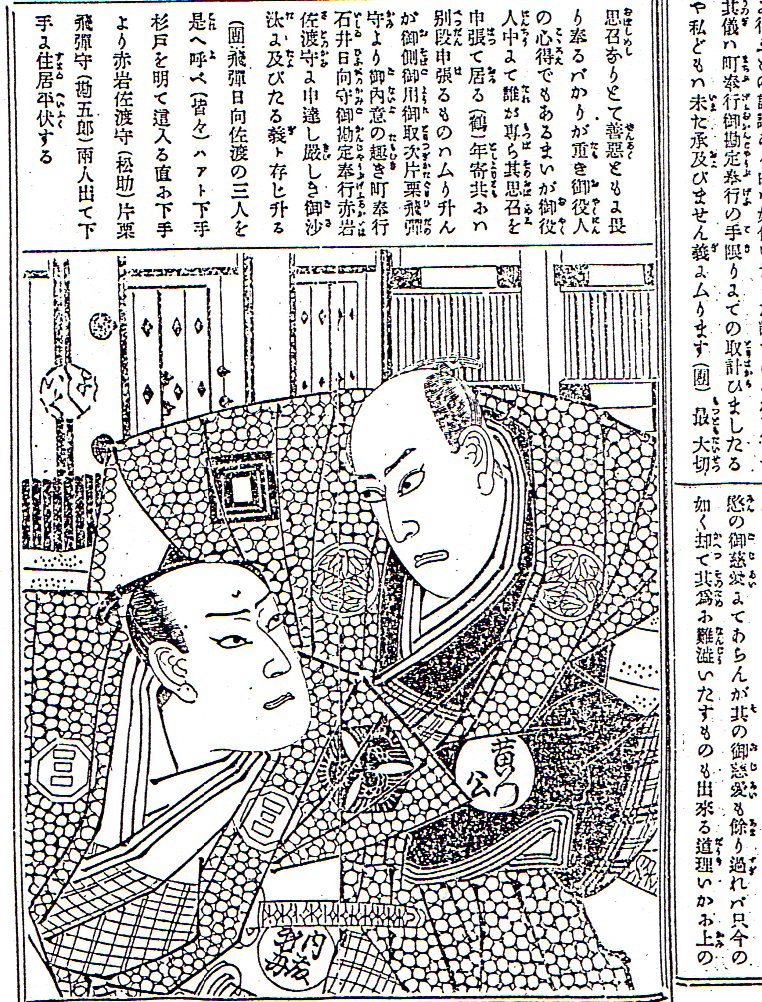
Newspaper announcement for Kōmonki, first play produced at the Kabuki-za. From Kabuki Shinpō.
For a time, after hearing of Kanya’s having created a syndicate controlling theatres and actors, Ōchi and Chiba sneered at the idea but, when their attempts to crush the alliance and to drive a wedge between Danjūrō and Kikugorō failed, Ōchi’s competitive spirit arose and he said that if he couldn’t get actors he’d don makeup himself and go on stage. After various complications, statesman Inoue Kaoru (1836-1915) entered as an intermediary and, finally, Chiba settled the matter for 20,000 yen by giving Kanya 10,000 yen and making a 10,000 yen gift to the Shintomi-za, thereby acquiring access to the actors.

Thus with the Shintomi-za troubles behind it, the Kabuki-za was able to put together a grand lineup of stars for its opening, including Danjūrō, Kikugorō, Sadanji, Takasagoya Fukusuke, Bandō Kakitsu, Kawarasaki Gonjūrō, Sawamura Gen’nosuke, Bandō Jusaburō, Ichikawa Kodanji, Bandō Shūchō, Ichikawa Yaozō, and Onoe Matsusuke. However, Ōchi, who had loudly advocated for reform and even had considered using the word “reform” in the theatre’s name, faced the possibility of being criticized for selling old wine in new bottles unless he offered new plays. But the time taken by the Shintomi-za troubles left him with a dearth of new material even as Chiba needed to see a return on his investment. Ōchi thus opted for safety by producing the play that had opened the Shintomi-za in 1877, Kōmonki Osana Gōshaku (The Story of Kōmon: A Lecture for Youth), by Kawatake Mokuami, with its original cast of Danjūrō, Kikugorō, and Sadanji (Dan-Kiku-Sa, as they were popularly known) along with the dance play Rokkasen (The Six Poet Immortals).
Mokuami’s play, originally titled Zokusetsu Bidan Kōmonki (A Great Traditional Tale: The Story of Kōmon), in which the central roles were Mito Mitsukuni, Fujii Mondayū, and Kappa no Kichizō, was revised by Ōchi, proponent of the reform movement, to include some of his reformist ideas. However, it showed signs that Ōchi’s plays and theatrical tastes were not going to be admired. (From Kaburagi Kiyokata, Koshikata no Ki). 
Even Ōchi wasn’t happy with this repertory since he considered such works nonsense. So, out of spite, he had the title printed as “A Great Traditional Tale,” beneath which came “The Story of Kōmon,” while the authorship was given in the program (banzuke) as, “Original work by Kawatake Mokuami, revised by Fukuchi Gen’ichirō.” This so enraged the usually mild-mannered Mokuami that after making an appearance at the first cast gathering (kaoyose) he is said to never have entered the Kabuki-za again nor write another play for it. (He died in 1893.) Okamoto Kidō recalled, however:  
Architect's rendering of Kabuki-za, front view. From Kenchiku Zasshi.

Side cutaway view of Kabuki-za. From Kenchiku Zasshi.
It’s a fact, though, that Danjūrō didn’t trust Mokuami. When I attended this play I went backstage with my father afterward and visited Danjūrō’s dressing room. My father faced the actor and asked him if a certain new scene (the one at Edo’s Ecchū) was by Mokuami. “Why on earth would Fukuchi write it? Couldn’t Mokuami have written it?” (From Okamoto Kidō in Fūzoku Meiji Tōkyō Monogatari.)
When the Kabuki-za’s construction was completed and its inspection finished, the peripheral fencing was removed, a placard was hung, saying “Opens on the 11th of this month,” and, that same day, the musicians offered a “large drum ceremony” (ōtsuzumi no shiki). 

Here's what a contemporary account in Seiji Gahō had to say about the splendid new theatre.
Exterior side view of Kabuki-za. From Kenchiku Zasshi.

Top: Third-floor ground plan; middle: second-floor ground plan; bottom: first-floor ground plan; note hanamichi at upper left and revolving stage at right. From Kenchiku Zasshi.
The theatre’s frontage is 15 ken (1 ken=around 6 feet) and its depth 30 ken, and it occupies 457 tsubo. It has narrow, vertical extensions (tsunoya) at either side, each as high as the main building. From the stage foundations to the beams is 30 shaku (1 shaku=around 1 foot), and the height of the left and right hallways is 20 shaku. The outside wall, based on the manager’s preference, is in classical Western style, covered in plaster with a design of musical instruments painted near the top so that a mere glance shows that the architect has built a theatre. The outside wall is built entirely of brick. Originally, it was planned that a statue of the auspicious Sanbasō character would adorn the façade but when it was realized that this might be dangerous the idea was abandoned. Inside, the theatre contains three floors in Japanese style, all of it made of cypress wood, which is not only beautiful but greatly enhances the acoustics.
Kabuki-za stage as seen from audience. Note chandelier under domed ceiling. From Kenchiku Zasshi.
The auditorium ranges from 13 to 10 ken in width, the main hanamichi is 5 shaku wide and 10 ken long, and the temporary (kari) hanamichi is 2 shaku 5 sun (1 sun=1.93 inches) wide and 10 ken long. The pit (doma), raised pit sections at the sides (takadoma), and uzura (side boxes) contain a total of 225 sections; the second-floor galleries (sajiki) contain 80 sections (occupying over 40 tsubo); and the third-floor galleries are the same. The third floor is 13 ken wide and 4 ken deep. The theatre has been designed to hold from 3,000 to 3,500 spectators. . . . [It actually held 2,066.] The stage and dressing room area ranges from 13 ken to 16 ½ ken in width. In the usual theatre the distance from stage to mizuhiki border over the stage is 11 shaku but at the Kabuki-za it’s 17 shaku, which increases visibility for those on the third floor, even when the stage floor is raised (by adding platforming). Also, the outer revolving stage (mawari butai) has a diameter of 9 ken while the inner one is 7 ken, it being an example of the “snake-eye” revolve (janome butai), one disk within another, in accordance with Japanese traditional practice. (From Akiniwa Tarō, Tōto Meiji Engeki Shi.)
On the evening of November 8 the company assembled for its first gathering (kaoyose). Since the principal actors were then engaged at the Shintomi-za, this took place after their performance in the lobby leading to the Kabuki-za’s third-floor seats. Danjūrō, Kikugorō, and Sadanji were there, as were Kanya, Mokuami, Ichikawa Shinshichi, and playwright Takeshiba Kisui, all seated in a row wearing formal hakama trousers and haori jackets. Things began with Mokuami rising and crossing to sit before managerial rivals Kanya, Ōchi, and Chiba Katsu to read aloud the title of the main play. Then Kisui took over and read aloud the prologue (jomaku) of Kōmonki, followed by a congratulatory handclapping of the assembled parties, and, before breaking up, the mutual sharing of good wishes by all.

On November 10, the playhouse’s completion ceremony (rakuseishiki) was held. The managerial team and the troupe leader (zagashira), Danjūrō, presided over a gathering of over 100 persons; a Shinto ceremony of the “Eight Directions” was held as were prayers for the prosperity of the new theatre.

Anyone from the past seeing this theatre would have been astonished by its splendidness. I remember thinking how gorgeous were the gas lights illuminating the Shintomi-za when I saw them but the Kabuki-za was like a grand temple of high-quality wood. The stage was also big and, unlike any of its predecessors, the auditorium had a third story. It was here that the cheap seat theatregoers (oikomi) were found, with the standing room (tachimi) area behind them. In order to watch by standing you removed your clogs (geta); experienced theatregoers were actually surprised by this reform.
Hanging from the ceiling over the pit was a winch-operated chandelier. The entire pit was built of movable floor boards. Among the theatre’s novelties was being able to raise some of these boards for seating, but this wasn’t well received and was done away with. The theatre was popularly known as the Reform Theatre (Kairyō-za). Then came the Meiji-za and the Tōkyō-za, but these take us too far; for the moment, the Kabuki-za ruled. (From Endō Tameharu, “Hōgobari” in Kisetsu Kabuki, vol. XVII.)
November 14, a highly auspicious day, was chosen for the beginning of rehearsals; a day later, on the 15th, the musicians assembled and played the ceremonial music of Takasago. On November 17 the banzuke programs were printed. There was consideration for the spectators’ needs, including not using the hard-to-read kantei ryū calligraphy style, abandoning the listing of actors’ names by rank in favor of role names, and the inclusion of role names for each scene. According to Tamura Nariyoshi:
This theatre’s reputation for reform meant that the customary banzuke were revised. The poster art of the Torii family was abandoned in favor of the art of Yoshitoshi’s pupil Toshikata, there were no actors’ crests, the title was written by Ōchi, and the previous method of listing the actors by rank, beginning with the troupe leader, was replaced by the names of the characters in order of their rank (for ex., in Chūshingura [The Treasury of Loyal Retainers] it would begin with Ashikaga Tadayoshi). (From Zoku Zoku Kabuki Nendaiki.)
These new practices led to the banzuke being called “reform programs,” which is where modern programs originated.

On November 21, the day of the opening ceremonies, the theatre’s exterior was decorated in Western style while an orchestra played inside and floral split curtains (noren) along with globe-shaped lanterns hung from the eaves of the adjoining teahouses.  A crush of spectators gathered outside, hoping to get in. By 3:00 p.m., the opening time, the crowd included horse-drawn carriages, an abundance of rickshaws, a crowd of invited governmental dignitaries, noblewomen, and other connected people. By 4:00 p.m., there was barely any space to breath.

On the reddish-brown drop curtain (donchō) made of silk damask was an embroidered image of Hōraisan (the mythical, inaccessible island included in classical Japanese gardens), with wave patterns to either side, creating a truly magnificent effect for a work of unparalleled luxury by master sewer Nui Hide costing 150 yen.

As 5:00 p.m. approached the curtain rose and Fukuchi Ōchi appeared, dressed formally in hakama and haori. He offered his thanks to the audience and, along with explaining the reform motives behind the construction of this theatre, said:
“Today’s productions, however, aren’t particularly reformist and don’t differ much from previous plays, which I think is my greatest regret. Sticking to my ideals, I will wait to offer true reform when we open next spring and ask that you reconsider your opinions.” He thus gave vent to his dissatisfaction at Chiba’s having prevented him from carrying out his ideas. (From Kimura Kinka, Kinsei Gekidan Shi: Kabuki-za Hen.)
Following this introduction, Kōmonki and Rokkasen were performed, with the show not ending until 11:30 p.m. The lateness of the hour and the disorderly throng of rickshaws waiting outside the teahouses raised a storm of angry protests among the theatregoers. There were also a good number of other complaints that irritated theatregoers, from the faux-reform production to problems related to the Western-style structure, such as the poor rake of the pit that made it difficult to see the stage and the inadequate acoustics produced by the high ceilings over the galleries. Snarky comments also arose because of disappointment with the difference between gas and electric lighting, the many speeches in Kōmonki of rough country characters, and the much reformed, unprecedentedly high ticket prices.

Eventually, on the ninth day, November 29, everything came off without a hitch, and with this the reform theatre came to nothing and was seen as little more than bluster. The only full house was opening day, with its invited audience, and attendance slipped from the second day forward. November 24, a Sunday, failed to sell out, it was December 1 before a full house was achieved. Despite being praised at the time as Japan’s foremost structure, and with a grand opening production featuring a cast headed by Tokyo’s top stars, Dan-Kiku-Sa, the Kabuki-za’s debut was a big flop. On top of all this, Kikugorō had to leave the show when he came down with a cold; he was onstage for only 28 days of the run.

Kawatake Shigetoshi summed up the significance of the Kabuki-za’s opening thusly:
1. The theatre’s innovative structure and system.  2. The theatre’s being the first to have a generic name (and its being representative of kabuki).  3. The presence as manager of Fukuchi Ōchi, an amateur with absolutely no theatrical background, who built it in accordance with his vision of a reform theatre. (From Nihon Engeki Zen-Shi.)
Akiba Tarō affirms what the Kabuki-za represented:
Thus the Kabuki-za—in its theatrical position, its structure, its production methods, its actors—truly stood head and shoulders among Tokyo’s playhouses. There really was absolutely nothing about it to detract from the Kabuki-za’s being in step with our country’s cultural development at the time and being the theatre of a civilized nation. There’s no doubt that the Kabuki-za’s appearance was a severe blow to the Shintomi-za, the Ichimura-za, the Nakamura-za, and the Chitose-za. From 1890 on kabuki’s fortunes were the same as those of the Kabuki-za. The foremost productions in Tokyo were those of the Kabuki-za. (In Tōto Meiji Engeki-Shi.)
Many years afterward, in 1951, when the Kabuki-za was rebuilt following its destruction near the end of World War II, Takahashi Sei’ichirō, then the director of the Japan Art Academy (Nihon Geijutsuin), and first director of the Committee for the Protection of Cultural Properties (Bunkazai Hogō Iinkai), wrote in the program:
When the magnificent Kabuki-za went up in Kobiki-chō in 1889, it contributed greatly to the pride felt by kabuki actors. The list of goals established by the Theatre Reform Society when it was created in 1887 included one stating: “To build a properly constructed auditorium which will be used for theatre performances, music concerts, song recitals, etc.” (trans. Brian Powell), but the Society failed to bring this about. However, through the efforts of Fukuchi Ōchi and Chiba Katsugorō Japan’s first grand, genuine Western-style theatre was erected. It was a big honor for actors to trod this great theatre’s cypress-wood floor and those who had not yet set foot on it polished their art so that they one day might do so. (From “Kabuki-za to Kabuki Haiyū,” in Kabuki-za Sujigaki.)
As for culturally interesting developments in 1889 Japan, there was much ado about flannel shirts, rose-colored glasses, and imported rice. Osaka star Nakamura Sōjūrō I died at 55. The year also saw the opening of the International Exposition in Paris. Among other important theatres built that year were Paris’s Théâtre des Capucines, Vienna’s Volkstheater, and London’s Garrick Theatre. It also was the year Strindberg wrote Creditors and “The Stronger,” and Chekhov wrote “The Wedding,” and The Wood Demon

Monday, August 1, 2016

THE FIRST KABUKI-ZA (1889-1911). Chapter 2: THE WATERFRONT AND EDOMAE

THE FIRST KABUKI-ZA

Samuel L. Leiter

Chapter 2
The Waterfront and Edomae1

[Note: This is Chapter 2 in a series devoted to the early history of the Kabuki-za. For the introductory chapter go to Chapter 1.  What follows is translated and adapted from Kabuki-za Hyakunen-Shi, edited by Nagayama Takeomi (1995). A team of 10 writers is listed but none are identified as having written specific chapters. Inessential material has been cut; references and added passages from other sources are in bold. Corrections and documented additions are welcome.]

In recent years the Tokyo waterfront has been in the spotlight as a place for advancing the internationalization and communication abilities of Japan’s capital city. Development plans by the city of Tokyo and the Japan Land Agency, from the coastal area to the river banks, include intelligent buildings with high-level communications, heliports, international conference facilities, apartment houses, sports and pleasure venues, and the mingling of people from all walks of life.

[Note: this was published in 1995, so much of this already is in place. The most detailed previous account of the material found in this chapter is in Komiya Toyotake, comp. and ed., Japanese Music and Drama in the Meiji Era, Vol. III (Music and Drama), trans. Edward G. Seidensticker and Donald Keene (Tokyo: Ōbunsha, 1956), and Theatrical Performances and
Theaters in the Meiji Era. For the best account of the Shintomi-za, see “Kabuki Goes Official: the 1878 Opening of the Shintomi-za” in Samuel L. Leiter, ed., A Kabuki Reader: History and Performance (Armonk, NY: M.E. Sharpe, 2002).]

There are snobbish-sounding English-language names for the area, like Waterfront or Tokyo Bay City, but the name with the closest connection to Tokyo is surely Edomae. The dictionary defines edomae (Edo-Before) as the sea fronting the Edo areas of Shiba, Shinagawa, etc.; its use began when the fish in these waters came to be appreciated as edomae products.  

The location of the Kabuki-za, now designated as Ginza, Chuo-ku, 4 chōme, 12-15, was called Kobiki-chō until August 1961.  Up until the Keian period (1648-52), this area, is said to have been called Edo Minato (Edo Port) and was the city’s waterfront. The origin of the name Kobiki-chō (Sawyers’ Street) comes from the many saw sellers who lived here when Edo Castle was rebuilt.
There were homes along the Sanjūkkenhori Canal, daimyō storehouses lined the eastern bank, the smell of the sea was in the air, and the sound of waves lapping at the shore could be heard. During the Manji period (1658-61) a land reclamation project was undertaken, moving the shoreline further away. And, after the great fire of 1657, the place where Shōchiku’s main offices now are located was filled in, giving the location the name Tsukiji, or “Built-Up Land.” When the project of reclaiming tideland was completed in 1658, the Nishi Hongan-ji Temple of Hama-chō, which was seeking additional land, was given a sizable plot covered by seawater; it’s said that the land was reclaimed by jworshipful fishermen. The temple faced the sea, the Bōsō Hill Range could be seen in the distance, and it occupied a substantial section of the bay area.

2. Tsukiji and Kobiki-chō

During the Kan’ei period (1624-44), Edo surpassed Kyoto as the largest city in Japan, but in 1657 the Great Fire of Edo, sparing only Nishimaru, destroyed Edo Castle. The government began rebuilding the city based on fire prevention plans; the daimyō mansions of the three branches of the shogunate house were relocated, as were the temples and shrines; these sites were rebuilt as firebreaks, the main streets were widened, and residential areas were reorganized. 

As a result, the areas of Mita, Honjō, Asakusa, Yanaka, and Fukugawa were added to the surrounding urban areas occupied by temples and shrines; the Yoshiwara brothel district and Kyōbashi’s Kobiki-chō were created in Tsukiji on the eastern side facing the sea; and land was prepared for new townsman housing. From then until the Meiji Restoration the neighborhoods of Kobiki-chō and Tsukiji were occupied by the residences of daimyō bannermen (hatamoto), after which the filled-in border of the Sumida River became South (Minami) Odawara-chō, with rows of fishmongers and small local shops.

In 1624, Saruwaka (Nakamura) Kanzabūrō set up a drum tower (yagura) over his new theatre, the Saruwaka-za, in Kyōbashi’s wide Nakabashi Street; this was Edo kabuki’s official beginning. Soon afterward it was moved in the direction of Negi-chō. Also going up in this Kobiki-chō neighborhood puppet theatres (ayatsuri shibai), sermon halls (sekkyōza), and so on. From the late Kan’ei period (1640s) to the Jōō period (1652-55) it was an active amusement street. It thus formed the roots of today’s Shōchiku amusement center.  
Stone monument in Kyōbashi marking the site of the first Saruwaka-za. The wording says that on the 15th day of Kan'ei 1 (1624) Saruwaka Nakamura Kanzaburo raised the ceremonial drum tower (yagura) to signify the opening of the Saruwaka Nakamura-za on this site, said to be the southern part of Naka Bridge (Nakabashi). This stone was placed here in hopes that the spot where the national drama of kabuki was originated would long be remembered. July 1957. Edo Kabuki Historical Preservation Society.  
In the fifth month of 1644 Okamura Kōhei received permission to build the Yamamura-za at Kobiki-chō, 6-chōme, after which he changed his name to Yamamura Chōdayū; in 1648, Kawarasaki Gonnosuke built the Kawarasaki-za at 5-chōme; and, in 1660, the Morita-za was erected at 5-chōme by Morita Tarōbei. The Kawarasaki-za eventually became the alternate theatre (hikae yagura) for the Morita-za. These venues remained here for many years before being transferred to Saruwaka-chō, in Asakusa, in the early 1840s as part of the Tenpō Reforms; during the early Meiji period, the Morita-za, moved back to the area, taking the name Shintomi-za ( from its location at Shintomi-chō. The Yamamura-za was closed down officially after the Ejima-Ikushima Incident of 1714.

During the Edo period a wide boulevard running east-west within the grounds of the Ekōin Temple in Ryōgoku was an amusement center, as were Okuyama in Asakusa, Nakano-chō in Fukagawa, the Hachimonji temple grounds, the Fukiya-chō riverside, and Kobiki-chō’s Unemegahara. Unemegahara, located on the eastern side of Kobiki-chō, 4-chōme, was, until 1724, the site of the mansion of the Iyo Imahara clan lord Matsudaira Uneme no Kami Sadamoto.  After it burned down and the family moved, it was called Unemegahara. In 1728 it was a horseback riding place across from where the Kabuki-za now stands and the place was busy with storytellers and other public speakers (kōshaku and mamezō).
Two views of Unemegahara.
According to the Fuzoku Gahō the area from Uneme Bridge’s (Unemebashi) northern side to Mannen Bridge (Mannenbashi), the area along the riverside resembled an amusement street until the late Edo period. There were many small kabuki theatres (koshibai) and storytelling (kōshaku) and puppet theatre establishments surrounded by reed mats, as well as teahouses, archery ranges, fishermen’s inns, shops selling sazae no tsubo yaki (turban cooked whole in its own shell) and inarizushi (sushi wrapped in fried tofu), one after the other, not to mention the many streetwalkers who waited in the evening shadows.

From the crossroads of the Ginza’s Owari-chō toward Tsukiji, the first bridge was Mihara Bridge (Miharabashi), and from there past the Kabuki-za, and toward Mannen Bridge from Furitsu Kōgei Gakkō toward Honganji Temple there were daimyō mansions. Four bridges, Mihara, Mannen, Uneme, and Kobiki, formed the area within which the Unemegahara equestrian training ground was situated. Across the road running past the Kabuki-za’s location was a daimyō mansion with a namakokabe wall to whose east was an open field, while beyond the horse riding grounds were many closely packed shops.

As already pointed out, the English word “waterfront” is a new, popular word that originally came into use in connection with the strong business interests involved in redeveloping the Tokyo Bay area; it’s an economic term used in relation to youth culture and urban customs and it has a modern cachet as a katakana word that leads to its frequent use in writing for the younger generation. Crowds of young people can be found at the many restaurants and saloons facing the harbors and canals, in places such as the Sumida River and the converted warehouses of Shibaura. Noticing the boom, warehouse owners have created eating and drinking establishments aimed at the youth market, often with cultural spaces such as galleries and a wide range of offerings
.
Whether you say Waterfront or Edomae, history truly repeats itself. 

3. Before the Kabuki-za

Kaburagi Kiyokata, born in 1878 in Sakuma-chō in Tokyo’s Kanda section, was an artist specializing in paintings of Japanese beauties (bijin-e), including the three works called “Akashi-chō” (19270, “Shintomi-chō” (1930), and “Hama-chō Kawagishi” (1930). He lived from age eight to 16 in Kobiki-chō. His father, Jōnō Saigiku, a journalist and novelist, was a patron of Ichikawa Danjūrō IX and Onoe Kikugorō V so he came to be called Jōnō Dankiku. In his autobiography, Koshikata no Ki, Kiyokata recalls Kobiki-chō and Tsukiji’s Shintomi-chō as they were in the late 1880s.

Before the construction began this area was part of Unemegahara, with street performers’ stalls, and the place was a great one for kids to enjoy themselves. Knowing that a theatre would soon be built there I remember going there with a maid on a moonlit night to fly my little kite. Then they began to build it and it was unlike any that had ever been seen before. When you looked at the auditorium and stage from the third floor it was like peering into a deep valley from a mountain peak.

Before the Kabuki-za went up the Shintomi-za was the representative major theatre; it also possessed a cypress wood stage (hinoki butai). It contained a substantial amount of Edo-period features, including a lineup of illustrated billboards (e-kanban) over a low “mouse door” (nezumi kido) audience entrance that Kiyokata always went to see first. These billboards were painted in distemper using thick lines and showing the actors dressed as their characters with their personal crests painted in brilliant Dutch ultramarine and their role names painted in red against a circular white background. Beneath the gabled roof beams was a black lacquered stucco circle in which was painted a wood sorrel (katabami) design representing the crest of the Morita-za. Two story-high teahouses were located to either side, colorful, crest-decorated Chinese paper lanterns hanging from them, creating the very picture of a theatre street.

The theatergoing experience that began with the Shintomi-za involved spending 13-14 hours in these theatres; it goes without saying that food and drink were necessary to get through such a long day. In Western theatres the intermissions between acts are short; to prevent the audience getting bored an orchestra is placed at the front of the stage, with the orchestra playing whenever the curtain falls. In our country’s theatres, though, the intermissions run for an hour. Since nothing is done to relieve the audience’s eyes and ears during these interludes, the spectators, cramped together buttock to buttock, take their pleasure by sipping tea, munching on pastries, downing sake, and eating food, both lunch and dinner, while breathing in the foul air. What looks like a theatre becomes a saloon creating a disgraceful scene of a crowd stuffing themselves in the large, crowded space. No matter how patiently you observe it, the bizarre sight of these spectators in an enlightened country is so shocking it’s if you were watching a competitive exhibition of Japan’s bad manners. (From Nakamura Zenpei, “Gekijō Kairyō Hō,” Meiji Bunka Zenshū, vol. 12.)

Clara Whitney, whose father came to Japan in 1868 to teach at what is now Hitotsubashi University, and who later married Katsu Umetarō, third son of statesman Katsu Kaishū, touches on the subject in her autobiography, Clara’s Diary: An American Girl in Meiji Japan (1979), which covers her life in Tokyo from the early through middle Meiji period. The teenage New Jersey girl left several descriptions of going to the Shintomi-za, including a minutely detailed record of the visit of ex-president Ulysses S. Grant in July 1887. Its depiction of the glorious event, with its glittering upper-class crowd, contrasts sharply with the first impression of those visiting kabuki at the long programs, filthy air, and patient endurance of the Japanese spectators.

Okamoto Kidō, one of the sharpest observers of Meiji kabuki, lovingly recorded the city’s customs and manners in a collection of essays called Fūzoku Meiji Tōkyō Monogatari, first published in 1987. In it, he wrote:

At the time, Kobiki-chō, 3-chome, was a desolate place while the other side at Uneme-chō had one house after the other. The 3-chōme side, that is, where the Kabuki-za now is, was all empty grassland. Aside from the circus and sumō matches occasionally held there, among other performances, it was just a vacant lot in the middle of Kyōbashi. . . . I always passed through Kobiki-chō, 3-chōme, on my way to and from school, and examined the sumō posters. Before long, there were stakes in the grassland for the construction of a theatre. (From Okamoto Kidō, “Kidō Ichiya Banashi—Kabuki to Shinpa to,” in Fūzoku Meiji Tōkyō Monogatari.)

4. Ready to Be Born

Thus, against a background in which the voices of theatre reform in the 1880s became even stronger with the first performance imperial viewing of kabuki, the Kabuki-za suddenly came into the limelight in a corner of Kobiki-chō.

After the Meiji Restoration the first concrete sign of a new age in kabuki was the building of the Morita-za in Shintomi-chō in 1872. This was against a background in which Kabuki theatres became places for the social elite, and, under the new Meiji government’s theatre policies, tools for advocating loyalty and patriotism and educating the people.

In 1888 the government and the kabuki world quickly drew closer while walking in step toward Westernization; the producer Morita Kanya XII and the great actor Danjūrō IX, pioneer of the new living history (katsureki) dramatic genre, were at the heart of the theatre reform movement. In 1886 the Theatre Reform Society (Engeki Kairyō Kai) was formed; this was a substantial organization including important people from the worlds of politics, finance, and education, as well as theate. In 1887 their efforts resulted in the epochal performance of kabuki before the emperor.

At its heart, the Theatre Reform Society, created as it was during the “Rokumeikan period,” was to make the theatre serve as an instrument in the attempts of the Itō Hirobumi cabinet to further Japan’s primary goal of revising the unequal treaties with Western powers it had been forced to live under since the 1850s. One of the aims of the Theatre Reform Society, established in August 1886, was to build a theatre perfectly appointed for the presentation of theatre and both musical and vocal concerts. The group even hoped for foreign actors to display their skills on the new stage.
In Low City, High City, Edward Seidensticker writes:

Improvement became an organized movement during the Rokumeikan Period, shortly after The Mikado was first performed in London. There seems to have been a link between the two events. The Mikado was the talk of the Rokumeikan set, which thought it a national insult. Proper retaliation, it seems, was the creation of a dramatic form that foreigners had to admire, in spite of themselves. The Society for Improving the Theatre [i.e., Theatre Reform Society] had among its founders the foreign minister and the education minister. The wantonness of the old Kabuki must be eliminated. An edifying drama, fit for noble ladies, domestic and foreign, must take its place.

On October 19, 1886, a debate was held at the Bank of Tokyo on plans for the construction of a theatre, but on October 3, Suematsu Kenchō (Norizumi) delivered an address about theatre reform in the auditorium of the First Upper Middle School, Hitotsubashi, Kanda, Tokyo, an address that was widely disseminated in newspapers and magazines, as well as in book form. 

[Although Suematsu also touched on other theatre reform ideas] his purpose seems to have been to air his plans for building a new theatre: he would collect a capital of 150,000 yen and, in an appropriate location, build a three-storey brick theatre with chairs rather than the traditional straw-matted stalls. He would do away with the tea houses, and he would reform the system of footwear and the lavatories. He also proposed doing away with the hanamichi. . . . His argument seems to have been that architecture as the “base” on which the reformed theatre must rest. (From Toita Kōji, “The Theatre in Transition,” in Komiya Toyotake, Japanese Music and Drama in the Meiji Era.)]

On Empire Day, February 11, 1889, the Imperial Constitution, which remained in effect until Japan’s defeat in World War II, was promulgated and the city of Tokyo celebrated joyously. The same year saw the passage of the Imperial Household Act, which essentially established the Japanese imperial system. The emperor’s German physician, Dr. Erwin Baelz, who had come to Japan in mid-Meiji, noted with irony in his diary for February 9:

The entire city of Tokyo is making indescribable preparations for the promulgation of the constitution on 11th. Triumphal arches everywhere, plans for illumination and processions. The great joke is that no one has the least idea of what the constitution will contain! (From Erwin Baelz, Awakening Japan: The Diary of a German Doctor.)
Rendering of the first Kabuki-za. The vertical billboard (kanban) says: "Opening this month on the 15th." Actually, the theatre opened on November 11.
That same year, on November 21, the Kabuki-za was born.

Interior of the first Kabuki-za, May 17, 1893, during a production of Kanjinchō
The first Kabuki-za during its early years.


Saturday, July 16, 2016

THE FIRST KABUKI-ZA (1889-1911). Chapter 1: INTRODUCTION

Chapter 1:

INTRODUCTION

Samuel L. Leiter

Tokyo's Kabuki-za ranks among the most historically important theatres in the world. The victim of fires, earthquakes, bombing, and business decisions, its current incarnation--on the same site as its predecessors--is its fifth. The first lasted from 1899 to 1911, when it underwent a large-scale renovation. The second version survived from 1911 to 1921, the third from 1925 to 1945, the fourth from 1951 to 2010, and the fifth was opened in 2013. The essay below is the first in a planned series--based on a 1995 Japanese book called Kabuki-za Hyakunen-Shi published to commemorate the theatre's first hundred years--that will cover the Kabuki-za's history, year by year, from 1889 to its do-over in 1911. Hopefully, if I live long enough, the series will continue after that as well. 

The series begins with an excerpt from Chapter Twelve, “Playhouses, Programming, and Plays” in my Kabuki at the Crossroads: Years of Crisis 1952-1965 (Leiden: Global Oriental, 2013). It is edited and abbreviated from the original version, which surveys the Kabuki-za’s history through 1965. What stands on the same site now is the theatre’s fifth version; it opened in 2013.

Please click on the images to see full versions of them.

THE FIRST KABUKI-ZA

Samuel L. Leiter

In April 2010 a large sign with an electronic countdown mechanism stood in front of Japan’s most famous theatre, the Kabuki-za, noting the number of days left before the theatre closed down so that its Momoyama-style façade and postwar modern interior could be demolished.1 That day came on April 30, 2010; a year later, a large hole demarcated by white construction walls here and there adorned with the traditional green, black, and persimmon stripes of the kabuki curtain, stood where the iconic playhouse had been since January 1951. Of course, that theatre was only the latest in a series of Kabuki-zas that had occupied the space since 1889, and it would not be the last, as yet another Kabuki-za opened there in 2013, with a façade resembling the world-famous one incorporated into the front of a towering office building, and an updated replica of the stately, red-carpeted lobby now gone. The theatre’s entire last year was celebrated with each month’s program being called “Sayonara Kabuki-za,” and on the day after its last show ended, the theatre was packed for a farewell ceremony, with well-wishers there to wish this great playhouse goodbye.

[1. Engineers have determined that the theatre was not sturdy enough to withstand a severe earthquake.]

Ever since opening in the late nineteenth century, the Kabuki-za had ruled the roost among all theatres in Tokyo, not to mention Japan, even when more elaborate ones, like the Kokuritsu Gekijō (National Theatre, 1964), were built. It was here, in Tsukiji, that Japan’s foremost kabuki actors starred, beginning with Ichikawa Danjūrō IX and Onoe Kikugorō V; the Kabuki-za was to Japan what, for their respective purposes, Drury Lane and Covent Garden were to London, the Comédie Française to Paris, the Bolshoi to Moscow, and the Metropolitan Opera House to New York. It experienced some rough times between 1951 and 1965, but, despite serious slumps when—to the dismay of many theatre fans—other types of performance began to invade its cypress wood stage, it continued to be the main producer of kabuki into the twenty-first century, and will undoubtedly follow that path in its newest incarnation.

The first Kabuki-za opened in November 1889 exactly where its newest version is.2 When permission to build it was sought it was called the Kairyō Engekijō, but this soon became either the Kairyō-za or Kairyō Gekijō; all mean Reform Theatre. The founders, Fukuchi Gen’ichirō (Fukuchi Ōchi; 1841–1906) and businessman Chiba Katsugorō (1833–1903), built it in the section then known as Kobiki-chō on the grounds of a former daimyō mansion after purchasing it from the government. Until the Meiji period kabuki theatres were known by the family names of their proprietors, who were usually actors: thus, the three famous Edo theatres (Edo sanza) were the Ichimura-za, the Morita-za, and the Nakamura-za. Morita Kanya XII (1846–1897) broke the tradition in 1872, when he moved his Morita-za from Asakusa, to which it was forced to move in the early 1840s, back to the heart of the city in the Shintomi-chō section (easy walking distance from where the Kabuki-za would be built); there, it took the name Shintomi-za.

Fukuchi, son of a Nagasaki doctor, knew both Dutch and English, and had visited the West with the first government delegations, serving as their sole interpreter. Theatergoing was part of the agenda, and when Fukuchi noticed the people in his group falling asleep because they could not follow the dialogue—to the annoyance of their Western hosts—he began to explain the plots before the play began and the sleeping problem mostly disappeared. This is how he began to learn about the theatre.

[2 I rely here on Watanabe Tamotsu, Watashi no “Kabuki-za” Monogatari (My “Kabuki-za” Story) (Tokyo: Asahi Shinbun Shuppan, 2010), 20–37, and Nagayama Takeomi, ed., Kabuki-za Hyakunen-Shi, Honbun Hen 1 (Hundred Year History of the Kabuki-za, Main Volume 1) (Tokyo: Shōchiku Kabushiki Gaisha Kabuki-za, 1995), 39–63. The latter source provides many excellent illustrations.

3 Yuichirō Takahashi, “Kabuki Goes Official: The 1872 opening of the Shintomi-za,” in Samuel L. Leiter, A Kabuki Reader (Armonk, NY: M.E. Sharpe, 2002): 123-151.]

Back in Japan, much of kabuki seemed nonsensical to him compared to the more rationalistically based theatre he had seen in the West and he began discussing with the progressively-minded Danjūrō IX ways of reforming the stage. Meanwhile, Fukuchi had become a leading journalist and editor, with his hand in politics as well. With capital supplied by the financier Chiba and the support of Japan’s leading actor a new playhouse was planned that would put Fukuchi’s reformist ideas—part of a theatrical reform movement (engeki kairyō undō) that emerged in the late 1880s—into use.4 Thus the new theatre was founded not as a base for traditional kabuki performance but as an advanced, modern, innovative enterprise designed to raise Japanese theatre to a level comparable to theatre in the West, something happening in almost every other area of Japanese life at the time. Even its Western exterior reflected this obsession with foreign standards.5 But the new theatre had to overcome the objections of Kanya, who gathered the four major theatres of Tokyo at the time—the Shintomi-za, Nakamura-za, Ichimura-za, and Chitose-za (later Meiji-za)—into the Four Theatre League (Yonza Dōmei) as a conservative opposition to Fukuchi’s plans.

[4 For more details on these developments, especially the Theatre Reform Movement, see Brian Powell, Japan’s Modern Theatre: A Century of Continuity and Change (London: Japan Library, 2002), and Powell’s “Theatre Cultures in Contact: Britain and Japan in the Meiji Period” in The History of Anglo-Japanese Relations 1600-2000, Vol. 5, ed. By G. Daniels and C. Tsuzuki. See also Komiya Toyotake, comp. and ed., Japanese Music and Drama in the Meiji Era, Vol. III (Music and Drama), trans. Edward G. Seidensticker and Donald Keene (Tokyo: Ōbunsha, 1956), and “Theatrical Performances Theaters in the Meiji Era.”

5 The theatre’s exterior was built of brick in classical Western style, while the interior, which could seat from 3,000 to 3,500 on three levels, had a large, 36-lamp, electric chandelier hanging from the ceiling. All the seating was in top-quality cypress wood masu-boxes (chairless seating in boxed off sections holding five people on an earthen floor), and the stage equipped with two hanamichi (runways) and a janome mawari butai (a revolve within a revolve, each moving in a separate direction) making it ideal for kabuki. The architect was Englishman Josiah Conder (1852-1920), whose work in Japan also included the famous Rokumeikan, patronized by those Tokyo elite preoccupied with demonstrating their Western manners and fashions.]

In 1888, before it was built, the theatre’s name was changed to the Kabu-za, which, using the first two Chinese characters in kabuki—歌舞— meant “Song and Dance Theatre”; however, kabu, written with another character, , can mean radish; a synonym for radish, daikon, was used to refer to lousy actors,3 so Kabu-za was replaced by Kabuki-za, first used by Fukuchi in a September 18 newspaper article about the Four Theatre League, whose support was crucial to the Kabuki-za’s realization, since its actors were necessary for the formation of a troupe. When the theatre opened, it played it safe by offering a traditional program, but on its second program, a reformist play was introduced.

In the late nineteenth century, despite the long history of the word kabuki, it was more common to refer to it as shibai; later, shibai could refer to a range of theatrical genres, but at the time it meant only kabuki. Calling the theatre the Kabuki-za was a ploy to defer to conservative forces by employing a word that conjured up the conventional old-time theatre despite the venue’s intended progressive agenda. This contradiction arose because of the contemporary tension between indiscriminate acceptance of all things Western and the fear of losing essential elements of traditional culture.
Exterior of the first Kabuki-za. From Tōtō Meishō Zue.
Unfortunately, the reformist plays—mainly history plays based on antiquarian research—fizzled when it came to audience interest, much to Danjūrō’s chagrin. More problems emerged in 1894 when there was a sudden interest in realistic, jingoistic war plays based on the Sino-Japanese conflict; in May 1895, the most successful producer of such plays, the non-kabuki actor Kawakami Otojirō (1864–1911), was permitted to use the Kabuki-za stage, where his success was so great he was invited back in July. Danjūrō refused to return until the stage floor was scraped clean. In fact, a compromise was reached when it was agreed that the stage would be scrubbed with lye. Danjūrō now resolved to focus on revivals of traditional kabuki. To a kabuki actor the stage was a sacred place, especially the cypress wood flooring used for the classics. Danjūrō’s decision to treat his home stage as sacred and return to the classics was an important historical moment. And his renewed attention to preserving the classics in the face of competition from rising new forms such as shinpa (of which Kawakami was a founder), made the Kabuki-za Japan’s foremost venue for traditional kabuki, a reputation preserved by all the actors who succeeded to leadership after Danjūrō’s death in 1903. Almost every one of them had an artistic or family connection to Danjūrō, and saw it as their inherent duty to carry on his goals and keep the cypress stage unsullied.
Second Kabuki-za (after 1911 renovation of first one). From Kabuki-za Hyakunen-shi.  
As noted, the original Kabuki-za was built with a Western-style exterior, but in mid-1911, just as the Meiji era was shading into Taishō (1912–1926), this was renovated to resemble traditional architecture based on Japanese shrine structures. That year, the Teikoku Gekijō (Imperial Theatre, still in use after several renovations) had opened in Tokyo with a completely Western-style interior and exterior making it look much like any ornate theatre in Europe or America, so the Kabuki-za responded by reminding the public that it housed and maintained traditional Japanese theatre, even though an alternative approach might have been to emulate the general look of an actual Edo-period theatre using modern materials.

The renovated theatre lasted only a decade; in 1921, on the morning of October 30, a short circuit in the wiring caused a fire that burned the theatre down. When rebuilt, the theatre was different from its predecessors. It had three Momoyama-period gables above the facade, which foreshadowed the similar style of the postwar version. Unhappily, just before the expected date of completion, the Kantō Earthquake occurred on September 1, 1923, and it burned down yet again. Finally, the new theatre opened on January 4, 1925. Its life span was twenty years because on March 25, 1945, the theatre was destroyed by American B-52s in an air raid. The Kabuki-za was rebuilt and opened in January 1951, with the large central gable eliminated, leaving the two smaller ones, and with a number of other changes, inside and out.6

[6 As previously noted, the 1951 theatre was torn down in 2010 and rebuilt in 2013. For the theatre’s history through 1965 see my Kabuki at the Crossroads.]

Thursday, March 17, 2011

When Kabuki Survived the Bombing of Japan

The following is adapted from my essay, "From Bombs to Booms: When the Occupation Met Kabuki," in my edited book, Rising from the Flames: The Rebirth of Theatre in Occupied Japan, 1945-1952 (2009). Some may find it interesting in light of the current tragedy in Japan. A number of changes have been introduced to make the original more accessible to general readers.

Japan is no stranger to apocalyptic disaster. Prior to the recent earthquakes and tsunami, no catastrophe was as destructive to the country’s civilians as World War II. Yet, despite the mindboggling damage to many of Japan’s major and minor cities, and the unprecedented toll on life and limb, the nation was rebuilt at an impressive, even astonishing rate. Not only its homes, businesses, and infrastructure were rapidly restored but its culture too proved indestructible. One of the most visible aspects of that culture was its popular traditional theatre, kabuki, which was up and running only days after the war ended.

As the conflict reached its climax, and firebombs wiped out neighborhood after neighborhood, well over half of Tokyo’s 7 million residents fled the flames. Two weeks after the war ended, one in ten Tokyoites was living in some form of temporary space, including air-raid shelters; many were encamped beneath the city in the corridors of Ueno Station. The city’s population had decreased by perhaps 2,400,000 since the war began. Typhus raged that first winter, thousands being afflicted, many mortally. Whether at work, school, or the theater, people were chilled to the bone, despite being bundled up in whatever warm clothing or rags they could find.

Large portions of downtown Tokyo had been bombed to smithereens, and most of the still standing theaters had been closed down. The major kabuki venues of the Meiji Theatre, Kabuki Theatre, and Shinbashi Playhouse, had all been destroyed in air raids, the Meiji on March 10, the others on May 25. In June, the only kabuki program available was in Kyoto, and July saw none anywhere. Shows, normally running all day long, were required by wartime law to end within two and a half hours, and the theater had to be evacuated in case of an air raid.

The day the war ended, August 15, the sole kabuki program in Japan was a modest program at the Tōkyō Theatre, a few blocks from the now useless Kabuki Theatre and Shinbashi Playhouse. It featured the Ennosuke Troupe, led by Ichikawa Ennosuke II (1886-1963), in Yaji and Kita, a modern adaptation of the famous nineteenth-century picaresque novel, Shank’s Mare, and Benkei on the Bridge, a familiar dance-drama adapted from a noh play. The program had opened on August 8, two days after the atom bomb had been dropped on Hiroshima, and a day before the same fate befell Nagasaki. The show went on regardless, even though only six actors were available to perform. When the surrender was announced, the production closed.

Getting home during raids was difficult because public transportation came to a halt at such times. Some theaters were used as shelters, but this was no guarantee of safety. On March 10, 1945, two thousand people took shelter from the air raids in the Meiji Theatre’s basement, but they all died when the building burned down. Many of Ennosuke II’s actors had left for safer places and, of the thirteen available, as few as six might show up on the day of a raid.

If people were hungry enough for theater under such conditions, it is no surprise to learn that, after a brief respite following the end of hostilities, they were back in their seats very quickly. Theater artists, who had had to endure enormous restrictions, both materially and legally, during the war, must have been extremely anxious to see what their fate would be in a defeated, demoralized, nearly demolished Japan. The very day the war ended, the venerable Minami Theatre in Kyoto, the only major city not bombed, produced a general song and dance show. All theaters were supposed to close for two weeks, but as early as six days later, August 22, heavily damaged Osaka provided the first postwar kabuki production at the Ōsaka Kabuki Theatre, with a bill of traditional plays performed by local favorites Nakamura Ganjaku II, Nakamura Tomijūrō IV, and others.

Osaka and Kyoto, apparently, were freer from GHQ oversight than Tokyo, which had to wait until Ennosuke II reopened his August program at the Tōkyō Theatre on September 1. The interrupted program had been produced as a “condolence” for war victims, and the same claim was made when it reopened. The new program replaced Benkei on the Bridge with another dance-drama, Black Mound. These plays were reminders of the kind of light entertainment that the military authorities forced actors to perform in the late stages of the war. In an instant, the theater business, hobbled as it was, was scrambling back to its feet. In September and October, the main company producing kabuki, Shōchiku, mounted full-scale programs at five theaters in three cities.

It was not long before the rubble-strewn streets of Tokyo’s major entertainment district, Asakusa, were filled with pleasure seekers looking for a good time, even before there were movie posters hung or neon lights glaring. The citizenry blithely mingled with the American GIs who only weeks before were out to kill them, and flocked to such colorful spots as the ruined Asakusa Kannon Temple, buying rice balls at makeshift stalls for seven yen apiece. For the moment, people were looking for anything that would help get their minds off the misery around them.

Ennosuke was extremely anxious to start producing theater as soon as possible. He later wrote:

Having a competitive nature as a theater artist, I was ashamed and dissatisfied that, even if the Occupation Army was coming to Tokyo, there would be no theater. I made three trips to the Metropolitan Police Department but the matter remained unsettled; thus I couldn’t open on August 29, when the Occupation forces arrived, but I finally managed to raise the curtain on September 2 [sic].


Ennosuke’s actors, fearful of the occupiers and hiding out in safe havens, were summoned to his home in Akashi, where he provided cushions for them to bed down on, giving the place the feeling of a student boardinghouse. His family overcame many obstacles in order to care for and feed the needy actors. Despite these and other difficulties, once the production opened, it drew large, if bedraggled crowds, the men wearing standard issue field caps, and carrying cloth shoulder bags, the women all in baggy trousers, and the audience looking more like beggars than pleasure-seekers. The theater and stage settings were shabby, a cardboard cutout forced to do service as the moon in Black Mound. At one point, Ennosuke as Yaji in Yaji and Kita did a comic dance to earn some money for food, and spectators with hungry bellies sympathized as never before. But audiences were also starved for entertainment, and they gratefully accepted whatever the actors offered. Compared to the scorched earth outside, the shabby stage spectacle seemed truly beautiful. The thirteen actors employed when the show opened—for two performances daily—were gradually supplemented by other troupe members who returned during the month, with one or two a day joining the cast; by closing day, there were twenty-seven, all given roles in Yaji and Kita.

Ennosuke’s program was a resumption of his interrupted one, so Tokyo would have to wait until October for a postwar program that signaled the beginning of the new era. Ironically, it was produced by Shōchiku’s rival, Tōhō, at the Imperial Theatre in October and November, starring Onoe Kikugorō VI’s troupe in the dance-play Mirror Lion and a new play, Ginza Reconstructs. Other forms of theater were also returning, especially the modern theatre (shingeki), which had its first postwar production the same month.

To get to the theater, one had to walk through wastelands of dust and debris that not long before were closely packed with shops and buildings. Productions operated under extreme hardship, with a frustrating lack of props, frequent theft of electric footlight bulbs, missing and ruined seating, rubble- and puddle-strewn auditoriums, and electric power shortages. The earliest shows had to be produced without the traditional white rice powder makeup and makeup brushes, with tattered kimono undergarments, and (because new ones weren’t available) torn and soiled tabi socks. Entire companies had to share a single bar of soap.

No company escaped the backstage crises caused by an absence of important props, as, for example, when, on the opening day at the Tōkyō Theatre of the classic dance-drama The Subscription List in 1946, it was realized at the last minute that there was no wide, round, lacquered sedge hat for the character of Yoshitsune. A long intermission ensued while the theater’s staff had to go searching for one in two local noh theatres, as a similar hat is worn in the noh play Ataka, on which The Subscription List is based. The audience was kept waiting as the orchestra improvised before the hat arrived. There was also an October 1945 production of Benten the Thief at the Shinjuku Number One Theatre when the traditional polka-dot hand towel used by the title character was nowhere to be found. A stage assistant improvised one by painting spots on a white hand towel and no one knew the difference.

In November 1947, when The Treasury of Loyal Retainers, the revenge drama to which the American censors most objected, was finally okayed for production, extraordinary efforts were made to secure all props, costumes, and wigs on time for the opening; however, someone noticed in mid-production that the pine tree for Act V, left standing by the theater’s backdoor, had been stolen. The dilemma was solved only after Shōchiku president Ōtani Takejirō ordered the stagehands to cut down his own nearby garden’s tree and rush it to the theater, allowing the act to open as if nothing unusual had happened.

But promise hung in the air, even though GHQ—despite its goal of democratization and its abolition in October 1945 of the fearsome Thought Police—quickly began its censorship of anything smacking of reactionary ideas. In practice, the Japanese people were exchanging their own pernicious brand of censorship, present since kabuki’s earliest days but especially stringent during the prewar and war years, for one bearing an American label. Still, kabuki sensed the historical moment and the record shows a period of intense struggle as it sought to find the correct path to take in the beckoning new age. If Japanese theatre could survive in the wasteland of postwar Tokyo, it could certainly overcome the obstacles of GHQ censorship. That, however, is another story of survival.