Saturday, July 16, 2016

THE FIRST KABUKI-ZA (1889-1911). Chapter 1: INTRODUCTION

Chapter 1:

INTRODUCTION

Samuel L. Leiter

Tokyo's Kabuki-za ranks among the most historically important theatres in the world. The victim of fires, earthquakes, bombing, and business decisions, its current incarnation--on the same site as its predecessors--is its fifth. The first lasted from 1899 to 1911, when it underwent a large-scale renovation. The second version survived from 1911 to 1921, the third from 1925 to 1945, the fourth from 1951 to 2010, and the fifth was opened in 2013. The essay below is the first in a planned series--based on a 1995 Japanese book called Kabuki-za Hyakunen-Shi published to commemorate the theatre's first hundred years--that will cover the Kabuki-za's history, year by year, from 1889 to its do-over in 1911. Hopefully, if I live long enough, the series will continue after that as well. 

The series begins with an excerpt from Chapter Twelve, “Playhouses, Programming, and Plays” in my Kabuki at the Crossroads: Years of Crisis 1952-1965 (Leiden: Global Oriental, 2013). It is edited and abbreviated from the original version, which surveys the Kabuki-za’s history through 1965. What stands on the same site now is the theatre’s fifth version; it opened in 2013.

Please click on the images to see full versions of them.

THE FIRST KABUKI-ZA

Samuel L. Leiter

In April 2010 a large sign with an electronic countdown mechanism stood in front of Japan’s most famous theatre, the Kabuki-za, noting the number of days left before the theatre closed down so that its Momoyama-style façade and postwar modern interior could be demolished.1 That day came on April 30, 2010; a year later, a large hole demarcated by white construction walls here and there adorned with the traditional green, black, and persimmon stripes of the kabuki curtain, stood where the iconic playhouse had been since January 1951. Of course, that theatre was only the latest in a series of Kabuki-zas that had occupied the space since 1889, and it would not be the last, as yet another Kabuki-za opened there in 2013, with a façade resembling the world-famous one incorporated into the front of a towering office building, and an updated replica of the stately, red-carpeted lobby now gone. The theatre’s entire last year was celebrated with each month’s program being called “Sayonara Kabuki-za,” and on the day after its last show ended, the theatre was packed for a farewell ceremony, with well-wishers there to wish this great playhouse goodbye.

[1. Engineers have determined that the theatre was not sturdy enough to withstand a severe earthquake.]

Ever since opening in the late nineteenth century, the Kabuki-za had ruled the roost among all theatres in Tokyo, not to mention Japan, even when more elaborate ones, like the Kokuritsu Gekijō (National Theatre, 1964), were built. It was here, in Tsukiji, that Japan’s foremost kabuki actors starred, beginning with Ichikawa Danjūrō IX and Onoe Kikugorō V; the Kabuki-za was to Japan what, for their respective purposes, Drury Lane and Covent Garden were to London, the Comédie Française to Paris, the Bolshoi to Moscow, and the Metropolitan Opera House to New York. It experienced some rough times between 1951 and 1965, but, despite serious slumps when—to the dismay of many theatre fans—other types of performance began to invade its cypress wood stage, it continued to be the main producer of kabuki into the twenty-first century, and will undoubtedly follow that path in its newest incarnation.

The first Kabuki-za opened in November 1889 exactly where its newest version is.2 When permission to build it was sought it was called the Kairyō Engekijō, but this soon became either the Kairyō-za or Kairyō Gekijō; all mean Reform Theatre. The founders, Fukuchi Gen’ichirō (Fukuchi Ōchi; 1841–1906) and businessman Chiba Katsugorō (1833–1903), built it in the section then known as Kobiki-chō on the grounds of a former daimyō mansion after purchasing it from the government. Until the Meiji period kabuki theatres were known by the family names of their proprietors, who were usually actors: thus, the three famous Edo theatres (Edo sanza) were the Ichimura-za, the Morita-za, and the Nakamura-za. Morita Kanya XII (1846–1897) broke the tradition in 1872, when he moved his Morita-za from Asakusa, to which it was forced to move in the early 1840s, back to the heart of the city in the Shintomi-chō section (easy walking distance from where the Kabuki-za would be built); there, it took the name Shintomi-za.

Fukuchi, son of a Nagasaki doctor, knew both Dutch and English, and had visited the West with the first government delegations, serving as their sole interpreter. Theatergoing was part of the agenda, and when Fukuchi noticed the people in his group falling asleep because they could not follow the dialogue—to the annoyance of their Western hosts—he began to explain the plots before the play began and the sleeping problem mostly disappeared. This is how he began to learn about the theatre.

[2 I rely here on Watanabe Tamotsu, Watashi no “Kabuki-za” Monogatari (My “Kabuki-za” Story) (Tokyo: Asahi Shinbun Shuppan, 2010), 20–37, and Nagayama Takeomi, ed., Kabuki-za Hyakunen-Shi, Honbun Hen 1 (Hundred Year History of the Kabuki-za, Main Volume 1) (Tokyo: Shōchiku Kabushiki Gaisha Kabuki-za, 1995), 39–63. The latter source provides many excellent illustrations.

3 Yuichirō Takahashi, “Kabuki Goes Official: The 1872 opening of the Shintomi-za,” in Samuel L. Leiter, A Kabuki Reader (Armonk, NY: M.E. Sharpe, 2002): 123-151.]

Back in Japan, much of kabuki seemed nonsensical to him compared to the more rationalistically based theatre he had seen in the West and he began discussing with the progressively-minded Danjūrō IX ways of reforming the stage. Meanwhile, Fukuchi had become a leading journalist and editor, with his hand in politics as well. With capital supplied by the financier Chiba and the support of Japan’s leading actor a new playhouse was planned that would put Fukuchi’s reformist ideas—part of a theatrical reform movement (engeki kairyō undō) that emerged in the late 1880s—into use.4 Thus the new theatre was founded not as a base for traditional kabuki performance but as an advanced, modern, innovative enterprise designed to raise Japanese theatre to a level comparable to theatre in the West, something happening in almost every other area of Japanese life at the time. Even its Western exterior reflected this obsession with foreign standards.5 But the new theatre had to overcome the objections of Kanya, who gathered the four major theatres of Tokyo at the time—the Shintomi-za, Nakamura-za, Ichimura-za, and Chitose-za (later Meiji-za)—into the Four Theatre League (Yonza Dōmei) as a conservative opposition to Fukuchi’s plans.

[4 For more details on these developments, especially the Theatre Reform Movement, see Brian Powell, Japan’s Modern Theatre: A Century of Continuity and Change (London: Japan Library, 2002), and Powell’s “Theatre Cultures in Contact: Britain and Japan in the Meiji Period” in The History of Anglo-Japanese Relations 1600-2000, Vol. 5, ed. By G. Daniels and C. Tsuzuki. See also Komiya Toyotake, comp. and ed., Japanese Music and Drama in the Meiji Era, Vol. III (Music and Drama), trans. Edward G. Seidensticker and Donald Keene (Tokyo: Ōbunsha, 1956), and “Theatrical Performances Theaters in the Meiji Era.”

5 The theatre’s exterior was built of brick in classical Western style, while the interior, which could seat from 3,000 to 3,500 on three levels, had a large, 36-lamp, electric chandelier hanging from the ceiling. All the seating was in top-quality cypress wood masu-boxes (chairless seating in boxed off sections holding five people on an earthen floor), and the stage equipped with two hanamichi (runways) and a janome mawari butai (a revolve within a revolve, each moving in a separate direction) making it ideal for kabuki. The architect was Englishman Josiah Conder (1852-1920), whose work in Japan also included the famous Rokumeikan, patronized by those Tokyo elite preoccupied with demonstrating their Western manners and fashions.]

In 1888, before it was built, the theatre’s name was changed to the Kabu-za, which, using the first two Chinese characters in kabuki—歌舞— meant “Song and Dance Theatre”; however, kabu, written with another character, , can mean radish; a synonym for radish, daikon, was used to refer to lousy actors,3 so Kabu-za was replaced by Kabuki-za, first used by Fukuchi in a September 18 newspaper article about the Four Theatre League, whose support was crucial to the Kabuki-za’s realization, since its actors were necessary for the formation of a troupe. When the theatre opened, it played it safe by offering a traditional program, but on its second program, a reformist play was introduced.

In the late nineteenth century, despite the long history of the word kabuki, it was more common to refer to it as shibai; later, shibai could refer to a range of theatrical genres, but at the time it meant only kabuki. Calling the theatre the Kabuki-za was a ploy to defer to conservative forces by employing a word that conjured up the conventional old-time theatre despite the venue’s intended progressive agenda. This contradiction arose because of the contemporary tension between indiscriminate acceptance of all things Western and the fear of losing essential elements of traditional culture.
Exterior of the first Kabuki-za. From Tōtō Meishō Zue.
Unfortunately, the reformist plays—mainly history plays based on antiquarian research—fizzled when it came to audience interest, much to Danjūrō’s chagrin. More problems emerged in 1894 when there was a sudden interest in realistic, jingoistic war plays based on the Sino-Japanese conflict; in May 1895, the most successful producer of such plays, the non-kabuki actor Kawakami Otojirō (1864–1911), was permitted to use the Kabuki-za stage, where his success was so great he was invited back in July. Danjūrō refused to return until the stage floor was scraped clean. In fact, a compromise was reached when it was agreed that the stage would be scrubbed with lye. Danjūrō now resolved to focus on revivals of traditional kabuki. To a kabuki actor the stage was a sacred place, especially the cypress wood flooring used for the classics. Danjūrō’s decision to treat his home stage as sacred and return to the classics was an important historical moment. And his renewed attention to preserving the classics in the face of competition from rising new forms such as shinpa (of which Kawakami was a founder), made the Kabuki-za Japan’s foremost venue for traditional kabuki, a reputation preserved by all the actors who succeeded to leadership after Danjūrō’s death in 1903. Almost every one of them had an artistic or family connection to Danjūrō, and saw it as their inherent duty to carry on his goals and keep the cypress stage unsullied.
Second Kabuki-za (after 1911 renovation of first one). From Kabuki-za Hyakunen-shi.  
As noted, the original Kabuki-za was built with a Western-style exterior, but in mid-1911, just as the Meiji era was shading into Taishō (1912–1926), this was renovated to resemble traditional architecture based on Japanese shrine structures. That year, the Teikoku Gekijō (Imperial Theatre, still in use after several renovations) had opened in Tokyo with a completely Western-style interior and exterior making it look much like any ornate theatre in Europe or America, so the Kabuki-za responded by reminding the public that it housed and maintained traditional Japanese theatre, even though an alternative approach might have been to emulate the general look of an actual Edo-period theatre using modern materials.

The renovated theatre lasted only a decade; in 1921, on the morning of October 30, a short circuit in the wiring caused a fire that burned the theatre down. When rebuilt, the theatre was different from its predecessors. It had three Momoyama-period gables above the facade, which foreshadowed the similar style of the postwar version. Unhappily, just before the expected date of completion, the Kantō Earthquake occurred on September 1, 1923, and it burned down yet again. Finally, the new theatre opened on January 4, 1925. Its life span was twenty years because on March 25, 1945, the theatre was destroyed by American B-52s in an air raid. The Kabuki-za was rebuilt and opened in January 1951, with the large central gable eliminated, leaving the two smaller ones, and with a number of other changes, inside and out.6

[6 As previously noted, the 1951 theatre was torn down in 2010 and rebuilt in 2013. For the theatre’s history through 1965 see my Kabuki at the Crossroads.]

Thursday, March 17, 2011

When Kabuki Survived the Bombing of Japan

The following is adapted from my essay, "From Bombs to Booms: When the Occupation Met Kabuki," in my edited book, Rising from the Flames: The Rebirth of Theatre in Occupied Japan, 1945-1952 (2009). Some may find it interesting in light of the current tragedy in Japan. A number of changes have been introduced to make the original more accessible to general readers.

Japan is no stranger to apocalyptic disaster. Prior to the recent earthquakes and tsunami, no catastrophe was as destructive to the country’s civilians as World War II. Yet, despite the mindboggling damage to many of Japan’s major and minor cities, and the unprecedented toll on life and limb, the nation was rebuilt at an impressive, even astonishing rate. Not only its homes, businesses, and infrastructure were rapidly restored but its culture too proved indestructible. One of the most visible aspects of that culture was its popular traditional theatre, kabuki, which was up and running only days after the war ended.

As the conflict reached its climax, and firebombs wiped out neighborhood after neighborhood, well over half of Tokyo’s 7 million residents fled the flames. Two weeks after the war ended, one in ten Tokyoites was living in some form of temporary space, including air-raid shelters; many were encamped beneath the city in the corridors of Ueno Station. The city’s population had decreased by perhaps 2,400,000 since the war began. Typhus raged that first winter, thousands being afflicted, many mortally. Whether at work, school, or the theater, people were chilled to the bone, despite being bundled up in whatever warm clothing or rags they could find.

Large portions of downtown Tokyo had been bombed to smithereens, and most of the still standing theaters had been closed down. The major kabuki venues of the Meiji Theatre, Kabuki Theatre, and Shinbashi Playhouse, had all been destroyed in air raids, the Meiji on March 10, the others on May 25. In June, the only kabuki program available was in Kyoto, and July saw none anywhere. Shows, normally running all day long, were required by wartime law to end within two and a half hours, and the theater had to be evacuated in case of an air raid.

The day the war ended, August 15, the sole kabuki program in Japan was a modest program at the Tōkyō Theatre, a few blocks from the now useless Kabuki Theatre and Shinbashi Playhouse. It featured the Ennosuke Troupe, led by Ichikawa Ennosuke II (1886-1963), in Yaji and Kita, a modern adaptation of the famous nineteenth-century picaresque novel, Shank’s Mare, and Benkei on the Bridge, a familiar dance-drama adapted from a noh play. The program had opened on August 8, two days after the atom bomb had been dropped on Hiroshima, and a day before the same fate befell Nagasaki. The show went on regardless, even though only six actors were available to perform. When the surrender was announced, the production closed.

Getting home during raids was difficult because public transportation came to a halt at such times. Some theaters were used as shelters, but this was no guarantee of safety. On March 10, 1945, two thousand people took shelter from the air raids in the Meiji Theatre’s basement, but they all died when the building burned down. Many of Ennosuke II’s actors had left for safer places and, of the thirteen available, as few as six might show up on the day of a raid.

If people were hungry enough for theater under such conditions, it is no surprise to learn that, after a brief respite following the end of hostilities, they were back in their seats very quickly. Theater artists, who had had to endure enormous restrictions, both materially and legally, during the war, must have been extremely anxious to see what their fate would be in a defeated, demoralized, nearly demolished Japan. The very day the war ended, the venerable Minami Theatre in Kyoto, the only major city not bombed, produced a general song and dance show. All theaters were supposed to close for two weeks, but as early as six days later, August 22, heavily damaged Osaka provided the first postwar kabuki production at the Ōsaka Kabuki Theatre, with a bill of traditional plays performed by local favorites Nakamura Ganjaku II, Nakamura Tomijūrō IV, and others.

Osaka and Kyoto, apparently, were freer from GHQ oversight than Tokyo, which had to wait until Ennosuke II reopened his August program at the Tōkyō Theatre on September 1. The interrupted program had been produced as a “condolence” for war victims, and the same claim was made when it reopened. The new program replaced Benkei on the Bridge with another dance-drama, Black Mound. These plays were reminders of the kind of light entertainment that the military authorities forced actors to perform in the late stages of the war. In an instant, the theater business, hobbled as it was, was scrambling back to its feet. In September and October, the main company producing kabuki, Shōchiku, mounted full-scale programs at five theaters in three cities.

It was not long before the rubble-strewn streets of Tokyo’s major entertainment district, Asakusa, were filled with pleasure seekers looking for a good time, even before there were movie posters hung or neon lights glaring. The citizenry blithely mingled with the American GIs who only weeks before were out to kill them, and flocked to such colorful spots as the ruined Asakusa Kannon Temple, buying rice balls at makeshift stalls for seven yen apiece. For the moment, people were looking for anything that would help get their minds off the misery around them.

Ennosuke was extremely anxious to start producing theater as soon as possible. He later wrote:

Having a competitive nature as a theater artist, I was ashamed and dissatisfied that, even if the Occupation Army was coming to Tokyo, there would be no theater. I made three trips to the Metropolitan Police Department but the matter remained unsettled; thus I couldn’t open on August 29, when the Occupation forces arrived, but I finally managed to raise the curtain on September 2 [sic].


Ennosuke’s actors, fearful of the occupiers and hiding out in safe havens, were summoned to his home in Akashi, where he provided cushions for them to bed down on, giving the place the feeling of a student boardinghouse. His family overcame many obstacles in order to care for and feed the needy actors. Despite these and other difficulties, once the production opened, it drew large, if bedraggled crowds, the men wearing standard issue field caps, and carrying cloth shoulder bags, the women all in baggy trousers, and the audience looking more like beggars than pleasure-seekers. The theater and stage settings were shabby, a cardboard cutout forced to do service as the moon in Black Mound. At one point, Ennosuke as Yaji in Yaji and Kita did a comic dance to earn some money for food, and spectators with hungry bellies sympathized as never before. But audiences were also starved for entertainment, and they gratefully accepted whatever the actors offered. Compared to the scorched earth outside, the shabby stage spectacle seemed truly beautiful. The thirteen actors employed when the show opened—for two performances daily—were gradually supplemented by other troupe members who returned during the month, with one or two a day joining the cast; by closing day, there were twenty-seven, all given roles in Yaji and Kita.

Ennosuke’s program was a resumption of his interrupted one, so Tokyo would have to wait until October for a postwar program that signaled the beginning of the new era. Ironically, it was produced by Shōchiku’s rival, Tōhō, at the Imperial Theatre in October and November, starring Onoe Kikugorō VI’s troupe in the dance-play Mirror Lion and a new play, Ginza Reconstructs. Other forms of theater were also returning, especially the modern theatre (shingeki), which had its first postwar production the same month.

To get to the theater, one had to walk through wastelands of dust and debris that not long before were closely packed with shops and buildings. Productions operated under extreme hardship, with a frustrating lack of props, frequent theft of electric footlight bulbs, missing and ruined seating, rubble- and puddle-strewn auditoriums, and electric power shortages. The earliest shows had to be produced without the traditional white rice powder makeup and makeup brushes, with tattered kimono undergarments, and (because new ones weren’t available) torn and soiled tabi socks. Entire companies had to share a single bar of soap.

No company escaped the backstage crises caused by an absence of important props, as, for example, when, on the opening day at the Tōkyō Theatre of the classic dance-drama The Subscription List in 1946, it was realized at the last minute that there was no wide, round, lacquered sedge hat for the character of Yoshitsune. A long intermission ensued while the theater’s staff had to go searching for one in two local noh theatres, as a similar hat is worn in the noh play Ataka, on which The Subscription List is based. The audience was kept waiting as the orchestra improvised before the hat arrived. There was also an October 1945 production of Benten the Thief at the Shinjuku Number One Theatre when the traditional polka-dot hand towel used by the title character was nowhere to be found. A stage assistant improvised one by painting spots on a white hand towel and no one knew the difference.

In November 1947, when The Treasury of Loyal Retainers, the revenge drama to which the American censors most objected, was finally okayed for production, extraordinary efforts were made to secure all props, costumes, and wigs on time for the opening; however, someone noticed in mid-production that the pine tree for Act V, left standing by the theater’s backdoor, had been stolen. The dilemma was solved only after Shōchiku president Ōtani Takejirō ordered the stagehands to cut down his own nearby garden’s tree and rush it to the theater, allowing the act to open as if nothing unusual had happened.

But promise hung in the air, even though GHQ—despite its goal of democratization and its abolition in October 1945 of the fearsome Thought Police—quickly began its censorship of anything smacking of reactionary ideas. In practice, the Japanese people were exchanging their own pernicious brand of censorship, present since kabuki’s earliest days but especially stringent during the prewar and war years, for one bearing an American label. Still, kabuki sensed the historical moment and the record shows a period of intense struggle as it sought to find the correct path to take in the beckoning new age. If Japanese theatre could survive in the wasteland of postwar Tokyo, it could certainly overcome the obstacles of GHQ censorship. That, however, is another story of survival.

Sunday, May 9, 2010

#18: Of Houseboats Rammed up Your Nose and Other Things Japanese

My last weeks in Japan are upon me and I soon will be having a lot of obligations, family and otherwise, to attend to, so it looks like I'll have to shut up the old blog shop for a while, if not for good. I may return with comments on kabuki-related issues, even after I'm home in New York, but for now the travels with Samurai-ta in Japan postings will fade into the nothingness from which they came.

This final (if that's what it is) posting will play hopscotch with some of my recent doings in Tokyo. Facebook friends will see links to several videos already posted on my FB page, so I hope familiarity doesn't breed contempt. As those videos reveal, one of my local visits was to the electronics capital of Japan, if not the world, the neighborhood called Akihabara. The weirdo geeks (otaku), who are obsessed with manga, anime, and all the other--often sexually kinky--facets of Japanese pop culture, were--unfortunately--not out in force when I got there, and the only oddly dressed kids were those involved in the "maid" fad on display in cosplay restaurants. I managed to get a few clumsy photos of girls in maid costumes handing out leaflets for their establishments--young people handing out leaflets in crowded Tokyo areas are as common as mosquitoes in summer--but some of the girls I spotted were unexpectedly camera shy and, when they spotted my Cybershot, would scatter like mice back into their holes. Here are a few of them.


"Maid" costume for rent at a costume shop.


I assure you, this is a rather "conservative" maid. Some get-ups, including totally blonde hair, are really eye-catchingly unique (and often bizarre).


Of course, maid dolls are everywhere in Akihabara, which sells minutely detailed 3-D figures of action heroes, pre-and post-nubile women, manga characters, monsters, and so forth.

The shops near Akihabara station sell every kind of electronic device you can imagine, and some of these places of business are of megascale proportions, especially chains like Bic Camera and Yodobashi Camera. They are simply mindnumbingly overwhelming. But Akihabara, as intimated above, also has become famous for its pop culture shops. One sizable bookstore I went into, K-Books, seen in this video, was filled with nothing but videos, books, and magazines on anime, manga, and related pornography. (Ah, suddenly the blog is getting lots of hits.)


Arriving in Akihabara.


Typical action figures.


 Gundam Cafe (named for a popular anime figure) opened recently in Akihabara, and there was a long line to get in when I was there.

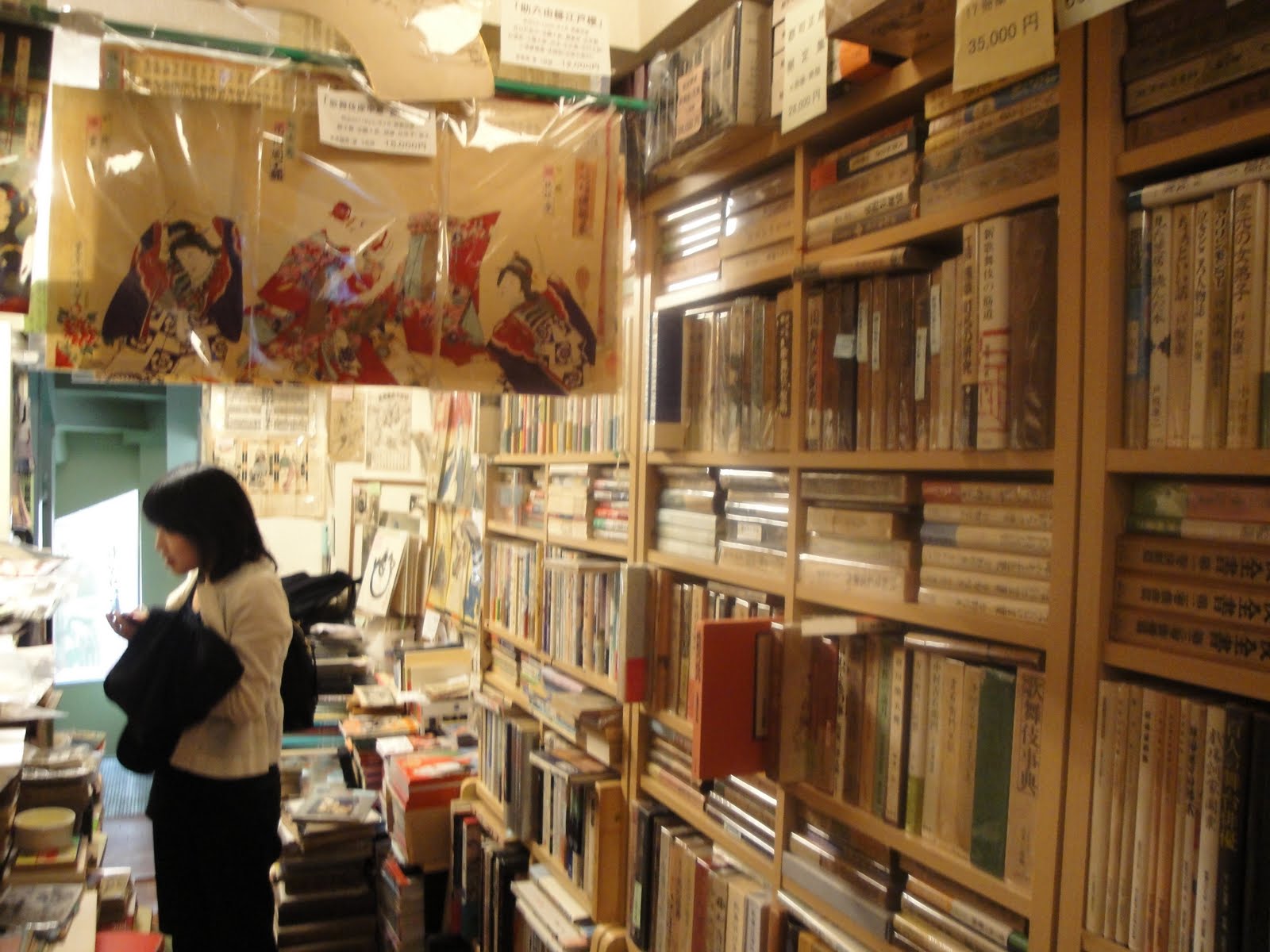
On another day, I had some business at the Kobikido bookstore I mentioned in an earlier posting. This is the hole-in-the-wall store across from the soon-to-be demolished Kabuki-za. As I said before, it's piled high with books, posters, and other theatrical effluvia, and is almost impossible to navigate because of the lack of space. Here are a couple of pictures.


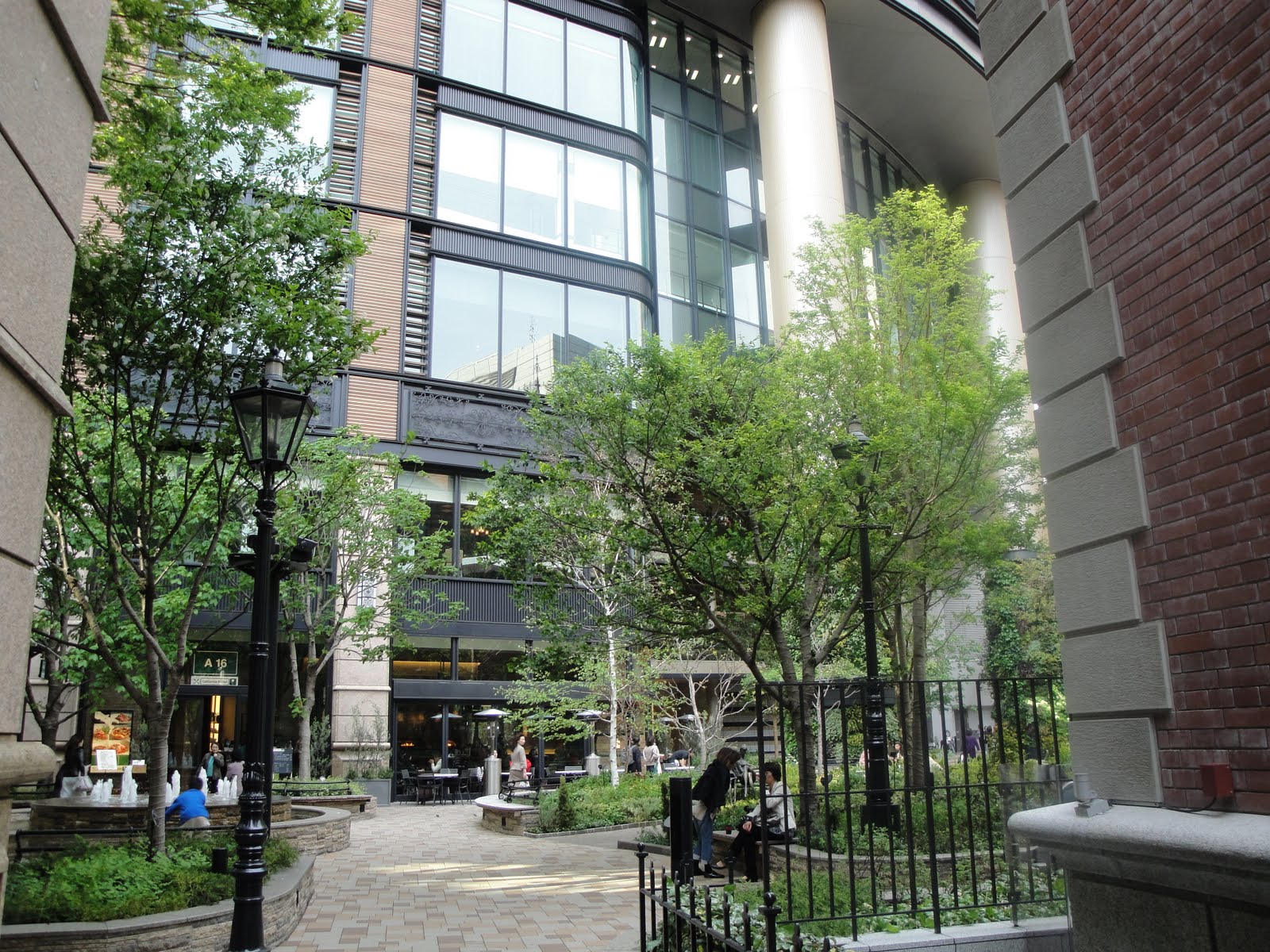
After I left the shop I decided to walk to the Imperial Palace gardens, which lie on the perimeter of the Imperial Palace grounds, about a mile or so from the Kabuki-za. The weather was mild, but getting cooler, so the walk was fairly comfortable, taking me down the first wide street to the north of the Kabuki-za through the Ginza and Yurakucho shopping districts, to the solemn, chilly office buildings of the Marunouchi district, which runs along the east side of the Palace. I was happy to see that a row of famous Victorian-style red brick buildings, near Tokyo Station, which had been threatened with destruction, was still standing, but the buildings, scrubbed clean, had been incorporated into a setting that dwarfed them by placing huge office towers in their backyards. A rather odd combination--"postmodern," is how my friend Kei Hibino describes it.


Do you agree?


Courtyard behind the red brick buildings, which now also contain a museum.

When, finally, I got to the Otemon Gate that lets you in to the Palace gardens, however, I discovered that the place was closed. Also closed, I soon learned, were all other attractions on the Palace grounds. Many other people were arriving to find that this is one of the many official places in Tokyo that are closed on Mondays. Happily, a subway that could take me home to Kichijoji (I hadn't moved yet) was nearby. Unhappilly, I was so tired that I slept through my stop and didn't get off until the end of the line. I knew where I was though, and was able to quickly backtrack and get to my real destination.


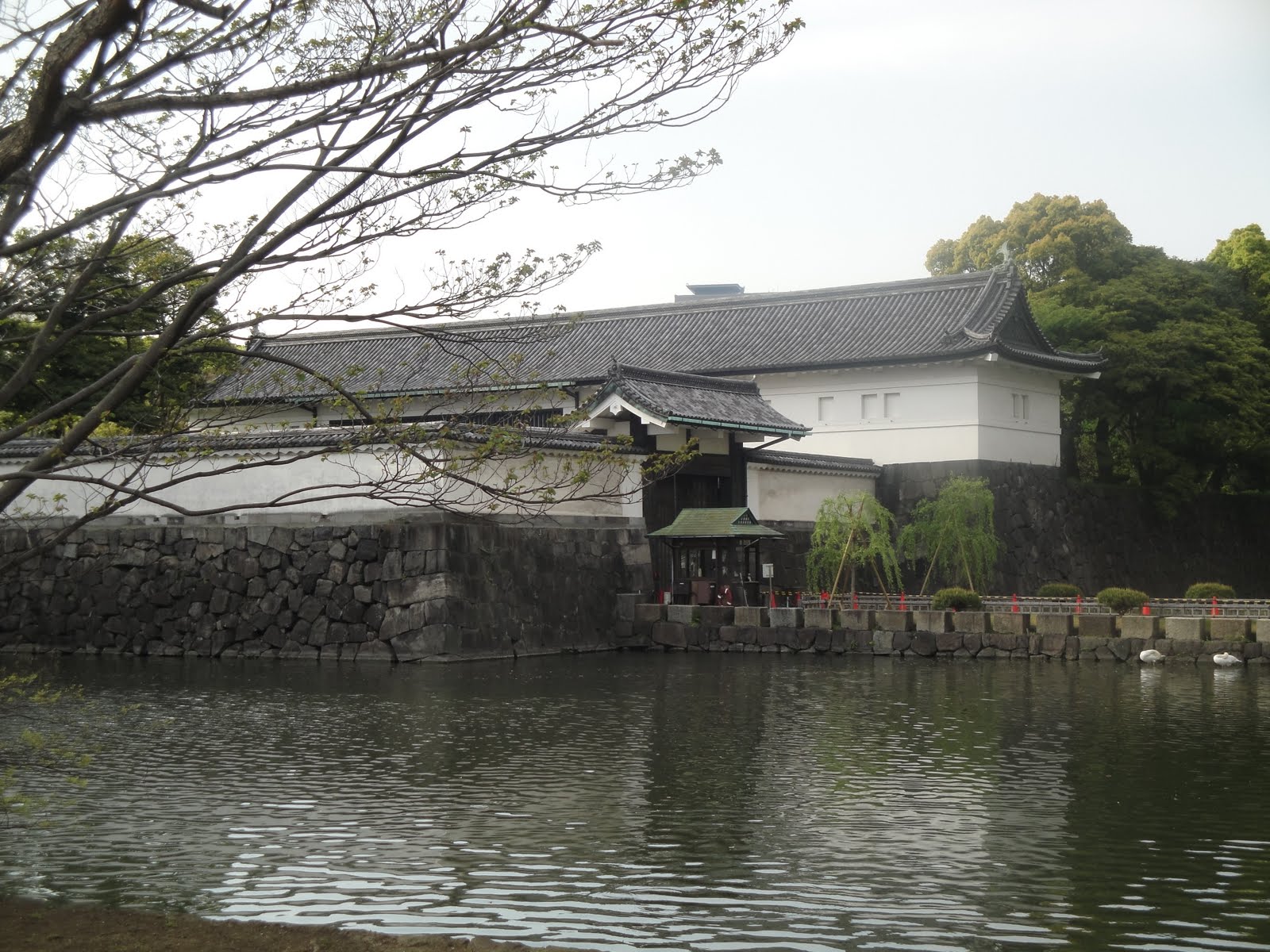
View toward Otemon Gate entrance along the moat outside the palace walls. The palace once occupied much more of central Tokyo (previously) Edo than now, and remains the single most valuable piece of real estate in the world.


Some features of traditional palace architecture can still be glimpsed from certain places on the fringe of the palace grounds.


The Otemon Gate into the Imperial grounds.


Directly in front of the entrance to Otemon Gate entry, whose name is on the signpost.

On May 2, I moved to an apartment in Meguro. My time at the Seikei University campus's I-House was up and I also needed a larger, more centrally located apartment. The one I moved to is a few minutes walk to Meguro Station, which is on the great loop line, the Yamanote, that circles central Tokyo; Meguro also has access to the Mita and Chiyoda subway lines. So it is extremely convenient. The neighborhood is a mixture of corporate and residential, with numerous apartment houses, and has countless restaurants of every type, big and small--Thai, Chinese, Indian, Western, soba, ramen, tenpura, sushi, tonkatsu, and on and on. Here is a tiny sampling of restaurant offerings, on display on signboards and plastic models in front of the shops.


A sumo-themed restaurant.


I'm convinced you could live here for several years and still not sample each local restaurant within ten minutes walking time of your stay. They are down alleys, down steps, up steps, up elevators, on office building floors entirely devoted to them. People stand outside them or near the station giving out flyers with discounts, or offers of a free course, or whatever, to lure you in.

The area is rather hilly, and my apartment house is on a particularly steep slope (a video of a truck going by is on an earlier post). I'm within walking distance of my good friends Reiko and Tsuyoshi, who live just off the Meguro River, which has lovely walking paths along either side, which took me there shortly after I moved in.


Looking down the path along the south side of the Shin Meguro Bridge toward my friends' residence.


Public pool along the way to my friends. Not yet ready for swimming, though. An adjoining building has an indoor pool.


More scenes along the riverwalk.


The shops lining the main drag near the apartment are standard issue, including convenience stores, a dry cleaner, ladies clothing, drug stores, used dry goods, and a barber, where I got my hair cut (the old-fashioned way). Here are a few for those who've never been to Japan.


Not far away is the very upscale Yebisu Gardens Place, a fashionable shopping center with a Mitsukoshi Department Store and the new Westin Hotel, among other charms, and I'm only two stops from the major shopping district of Shibuya. It took just 20 minutes from walking out my door to get to the Bic Camera store in Shibuya the other day.


Yebisu Gardens Place


Shibuya is a major hub for young fashionistas. I know my 18-year-old granddaughter, Briar, is interested in what the girls here are wearing, so I took a look for myself. The area near Shibuya Station is crammed with clothing and accessory shops for those seeking the faddiest Tokyo look, but one place in particular was a must-see, a 9-story department store called Shibuya 109, which is floor to ceiling, nook to cranny with local boutique names you never heard of. The sales clerks are themselves stunning examples of what's hot, and serve both as models and sales assistants to move the trendy goods along. I couldn't get over the buzz in the place, nor some of the extreme looks both customers and sales help were adorned with. Like so much else in this often nutty town, the impact was simply too much to absorb in one visit. I took some video but, because of the crowds and the way I was trying to film inconspicuously, the results came out half-baked. On the other hand, Google 109 and you'll be introduced to some videos with accompanying music that will either turn you on or turn you off to this youthful clothing frenzy.


This week, I went to the Shinbashi Enbujo to see two more kabuki programs, the only ones in town this month. As many of you know, a daily kabuki program in Tokyo follows the two shows a day (nibusei) system. But that's not two presentations of the same play(s). It's two separate programs, each with anywhere from three to five plays and dances. Sometimes, a single, long play occupies a program, and when The Treasury of Loyal Retainers (Kanadehon Chushingura) is produced in a full-scale production showing most of its 11 acts (something is usually cut, nonetheless), half may occupy one program and half the other. But ordinarily, since the original plays were usually all-day affairs, with episodic plots that allowed certain acts to practically stand on their own, only the most popular of such acts are revived. One such act can be anywhere from one to two hours (occasionally more when several scenes are involved), so going to a kabuki program is not unlike seeing the favorite scenes of The School for Scandal, Hamlet, Oedipus, and the Romeo and Juliet ballet. And the stars may appear in two, three, or more leading roles (in both dance and drama) during the day. A program runs from 11:00 a.m. to 4:00 p.m. The theatre is cleared, and the next program runs from 4:30 to 9:00 or later. The overworking of these brilliant actors has been discussed for decades, but the system still prevails.

This was Tokyo's first kabuki production since the bell tolled on the Kabuki-za's existence at the end of April (discussed in earlier blogs). Whereas the leading roles in the Kabuki-za's farewell programs were played by the major actors, this month's program was taken by the next generation of stars, the sons of those who were featured last month. These five actors are Nakamura Kantaro, Nakamura Shichinosuke, Onoe Shoroku, Ichikawa Ebizo, and Ichikawa Somegoro. A somewhat older actor who falls in between the two camps is the female impersonator (onnagata) Nakamura Fukusuke. The two programs, which totaled seven pieces, three of them dances, included three dramas shown last month at the Kabuki-za. Since I am here for only a couple of months, I would have preferred a completely different lineup of plays, but the point was to allow audiences to compare the acting of the younger generation, in their twenties and early thirties, with that of their seniors, whose names they will one day inherit.

There were some truly outstanding performances, but for me, the runaway talent of the event was Ebizo, son of Ichikawa Danjuro (one of kabuki's greatest names, if not its greatest). He played Matsuo in The Village School (Terakoya), the play I once directed Jimmy Smits in at Brooklyn College, which was played last month by Ebizo's uncle, Matsumoto Koshiro. The Danjuro line has a number of conventions for acting this role that differ from those of Koshiro, and Ebizo played them to the hilt, especially the moment when he examines the head of his own son, whom he has sent to the village school in hopes that the schoolmaster, ordered to execute another child, will subsitute Matsuo's son instead (all because of an obligation Matsuo has to the child's father). The feudal ethic displayed here is one reason the play was censored by the American military during the Occupation. But the truly most memorable performance was Ebizo's portrayal of the eponymous hero of Sukeroku, a role his father played last month, and one long associated with his grandfather, Danjuro XI, whom I saw do it in the early 1960s. Ebizo is a very handsome young man, especially in Sukeroku's white makeup with red lines around his eyes (see this link so I can avoid copyright issues); he has enormous charm and charisma, all of which are necessary to play this character, a dashing, heroic, romantic roustabout combining Cary Grant, Errol Flynn, and Gene Kelly in his swashbuckling, sometimes choreographic, and witty behavior. At one highlight moment of tongue twisting patter, he threatens to ram a houseboat up his enemy's nose. I love it! Ebizo has been criticized for not being as outstanding a dancer as he should be; he did no dancing during these programs, although his extended entrance on the hanamichi runway in Sukeroku, which involves a lot of complex choreography, could be considered dance. I was sitting up front and very near the hanamichi so I would have to have been Linda Blair to watch this sequence in total, but what I did see exposed no serious flaws that I could detect. Anyway, he's terrific and I hope I can see him again some day.

This has gone on too long, so maybe I'll be forced to add another posting describing my walk through the Yanaka neighborhood, near Nippori Station, which is one of the best places in Tokyo to escape the madness of the glass and steel skyscrapers and experience the feel of the prewar city. But it just may have to wait.

Wednesday, May 5, 2010

#17: Take Me Out to the Yakyu no Shiai

A lot has happened since I last put fingertip to keyboard. The biggest event was my moving from lovely Kichijoji to the heart (or one of the hearts) of Tokyo, in Meguro Ward. But more of that in a later blog. Today the subject is baseball. I'm still immersed in my research, but the day before I left Kichijoji, I took a break and visited a professional baseball game at (Meiji) Jingu Stadium, set in a beautiful park area filled with sports facilities. It was a simple ride on the Sobu line local from Kichijoji. Jingu Stadium is the home of those popular, low payroll, perpetual underdogs, the Yakult Swallows of Japan's Central League. Most Japanese teams have names affiliated with major corporations, not cities; thus, the Swallows are sponsored by a company that produces a very successful health drink called Yakult. On the other hand, the team the Swallows were playing was the Yokohama Bay Stars, named, of course, for the nearby city of Yokohama.

Jingu Stadium is a bit on the cheesy side, being rather old (built in 1926) and, though upgraded through the years, still much more like a dated minor league stadium than one hosting major (Japanese) league games. But it has the intimacy of places like Fenway Park and Wrigley Field, if nothing like their charm. This video, in which I find my seat, will give you a sense of the place.

The walk to the stadium takes about 10 minutes via an overpass from the station and past various sports facilities. Along the way you pass Meiji Memorial Picture Gallery, an imposing building containing images commemorating the reign of the Meiji emperor (1868-1912), who reigned when Japan began its journey into the modern world after being more or less closed off from international concourse for two and a half centuries. It looked especially impressive on the way back to the train, when it was beautifully lit.


Before dark.


After dark.

Other sights along the way to the game.


View from the overpass leading from the station to the ballpark.


Signpost pointing to all the local facilities, none of it in English. The second line from the top says "yakyu jo" (baseball field).


A resting place jampacked with Japan's ubiquitous vending machines.


The path is lined with vertical banners (nobori) of the Swallows' players, just like the traditional banners that used to advertise actors in kabuki, and still do in Kotohira, as per my recent blog.


The first of the long lines I encountered outside the stadium.

When I arrived at the ballpark, lots of people were already waiting in long lines, but the lines at the box offices were rather small. I asked for a good infield (naiya) seat, and for 4,500 yen (around $47.00), the top price, I got one a bit to the right of home plate, and had an excellent view of the field. Such seats at Citi Field or Yankee Stadium would be several hundred bucks. The area around me was sparsely populated, but by the time the game was underway, the outfield was pretty full. When I bought my tickets, the clerk asked me which team I supported, the home team or the visitors. For want of a better answer, I said the home team, so my ticket presumably placed me among other like-minded fans. When I entered the stadium, I was handed a bag of goodies, including stuff to help me root for the good old Swallows. Fans also brought or purchased tiny, colored, plastic umbrellas, which they bobbed up and down in unison at certain specified moments, such as during the seventh inning stretch, called "Lucky Seven," seen in this clip.

The game was called for 6:00, so I got there early. While the sun was out, it was quite comfortable, but as the evening darkened, I was glad to have brought along my jacket as the temperature dipped a bit and it became somewhat chilly. Getting there early allowed me to watch batting practice and to get the lay of the land.

The off the field antics were sometimes more fun than the game itself. The Bay Stars fans were packed into the left field bleachers, the Swallows' followers (say that ten times quickly) were in right. Throughout the game, whenever a batter went to the plate, his fans chanted or sang a ditty seemingly composed just for him and incorporating his name. The singing and chanting went on all night. Also, many fans throughout the place were equipped with small plastic bats that they rhythmically banged against each other in time to the music. On the first base side, facing the Swallows' infield patrons, a group of cheerleaders appeared several times to do choreographed routines, an especially catchy one being called "We Are the Swallows." And all night, the Swallows' personal announcer, a good-looking guy of mixed Asian-Caucasian heritage (I was unable to determine this precisely), wearing a baseball uniform, served as the team's most enthusiastic booster, speaking both Japanese and occasional English in a tone that sounded like Marv Alpert in his prime. You can hear a bit of this at the end of the video. I thought he was very impressive.

The crowd also got a kick out of "Bazooka Time," which, just as in American games is when the team mascots or other staff members shoot t-shirts into the crowd. You can see it in this video. Patrick Yu can be seen and heard on this clip. One other thing about projectiles: whenever a foul ball lofted into the stands over the protective fencing running down both sides of the infield (you can't get hurt by line drive fouls in Japanese parks), a female announcer's voice cautioned spectators to watch out for the flying object. Of course, by the time you heard her you either had caught the ball, avoided it, or suffered brain damage.

The fast food on sale was nothing like what you'd find at an American ballpark. The closest thing was thick franks on sticks. The only buns around were those you sit on. And the food was on sale only at the concessions under the stands. The vendors in the park proper were selling mainly beer, and they were everywhere, all of them cheerful young girls and boys who looked barely old enough to drink themselves. You could get Kirin, Yebisu, Asahi, and other brands, not just whatever big brand the team had a contract with. The closest thing to food was the ice cream being sold by a small number of vendors. The local citizenry hereabouts prefers to watch a game while slurping away at noodles in broth, or other popular Japanese confections. When I got hungry, I bought a box lunch of--guess what--sukiyaki!!

Here are some shots of the souvenir and food concessions, the field, and the fans.


The misspelling may appear quaintly amusing, but people who live in glass houses shouldn't throw stones.  Look around you in the U.S. and you'll see even worse examples. A sign near my house in Queens warns people not to throw "liter" on the ground.


A box office.


Those famous hot dogs on a stick from the un-Nathan's.


For lunch, I focused on this group of box lunches (bento), and chose the following one.


What it looked like when opened. The meat was cold but quite tasty. The egg was raw, as usual with sukiyaki, since you dip your meat in it. But seeing nowhere to pour the egg's insides, other than directly on the meat, I chose to do without it.

Now let's venture up the steps and into the stands.


No escalators here. Anyway, except for an area directly behind home plate, the stands are on only one level.


The second deck of stands, behind home plate.


The scoreboard actually does a good job of showing digital videos during the game, but in only one inning during the game I attended did it show the scores for other games going on elsewhere.


Batting practice.


There was a small number of foreigners at the game, including this American couple some rows in front of me, who had been brought there by their son. The latter was clearly an ex-pat, and his attractive Japanese girlfriend joined them in mid-game. I was trying to put their story together and decided that the parents had come to Japan to see their son and that a baseball game provided the best way for them to spend a night together in the company of the son's beloved (who knows, maybe she was his wife).


An argument on the field. Having read that Japanese baseball is a game of "wa" or peaceful solutions to onfield issues, I was amazed when a runner came sliding into homeplate and, being called out in a close play, rose immediately to his feet and roughly shoved the umpire. He was ejected at once, but this led to an argument from his manager, and the game didn't resume for about 10 minutes.


I'm sure you never saw someone carrying a bowl of soup and noodles back to their seats at Citi Field.


The fans rhythmically bobbed their colorful little umbrellas as the music played on several occasions, especially during the "Lucky 7."

By the end of the seventh inning, with the Swallows ahead 5-2, and the temperature dropping, I bade farewell to Jingu Stadium and made my last trip home to Kichijoji, to which I would say sayonara in the morning.